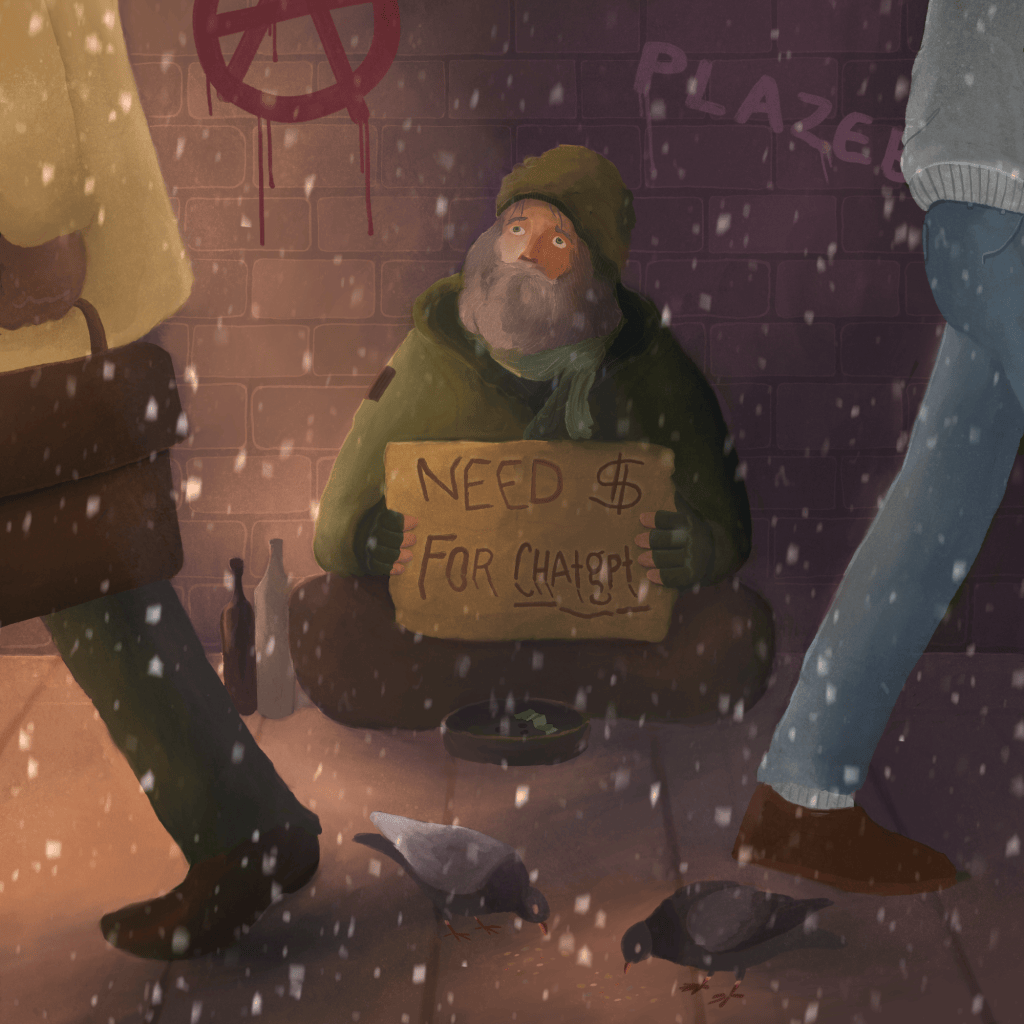
I can’t imagine where we’d be without generative AI. After all, thanks to AI, humanity has truly skyrocketed into the next age of discovery, free from the chains of labour that once plagued our meaningless lives. Now that the Tesla bots are running the factory lines, everyone’s out on the town, living life to the fullest.
I remember when Utopia was just a word, but these days, most have forgotten there ever was such a time. Without AI, there‘d still be millions of people across the globe living in poverty on the edge of starvation. There would still be enough nuclear weaponry and disease to wipe out the entire human race in a flash.
Can you imagine? A world where your every thought must be your own? Where your every move comes with a choice? I thank my lucky stars every night that I don’t ever have to know the pain of not knowing what to do next. If it weren’t for AI, how would we ever have solved the world’s most difficult challenges?
Sure, our planet is tearing at the seams and littered with roaring data centres that spit out sterile, uninspired gunk to flood out any sense of art and culture in society and enable mass surveillance on an unprecedented scale, but at least AI cured cancer, fixed the economy, and made the world a better place, right?
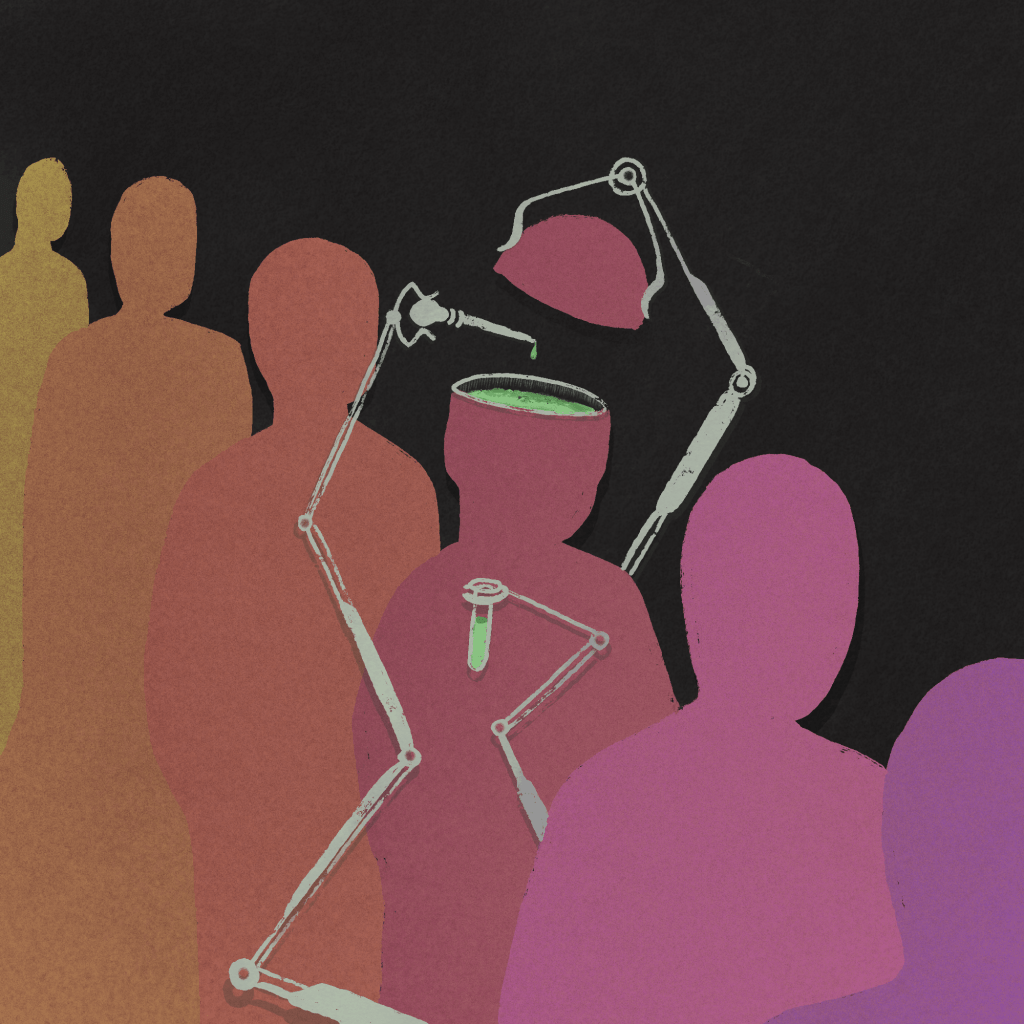
It is an honor to embrace my humility and admit that whatever I can do, AI can do better. That there is nothing special about being a human being. After all, what is a man if not an animal, and what is an animal if not a biological contraption. That is why, as of today, I have decided to stop writing this blog and allow my brain to be fused with AI entirely, transcending humanity and achieving true enlightenment.
Studies have shown that, given the opportunity, most students in academia are willing to cheat. In a series of surveys conducted over decades by Donald McCabe, 60% of students admitted to cheating in one form or another. Due to the nature of the questions in the survey, it’s fair to assume the real number is even greater. Another study from 2022 found that students were far more likely to cheat if they thought their classmates were cheating. Individual students may be unlikely to cheat on their own, but many wouldn’t turn down another student offering them a glimpse at the answer sheet. When it comes to following the rules, social pressure plays a major role in keeping us in line.
This pressure isn’t limited to cheat sheets. Because generative AI is so easily accessible and integrated into so many aspects of people’s lives, there is enormous pressure amongst students to use generative AI more and more, risking dependency especially because of the cumulative nature of higher education. There’s also an unspoken agreement between students that, while potentially unethical, using generative AI to complete assignments is not exactly cheating. This is no accident.
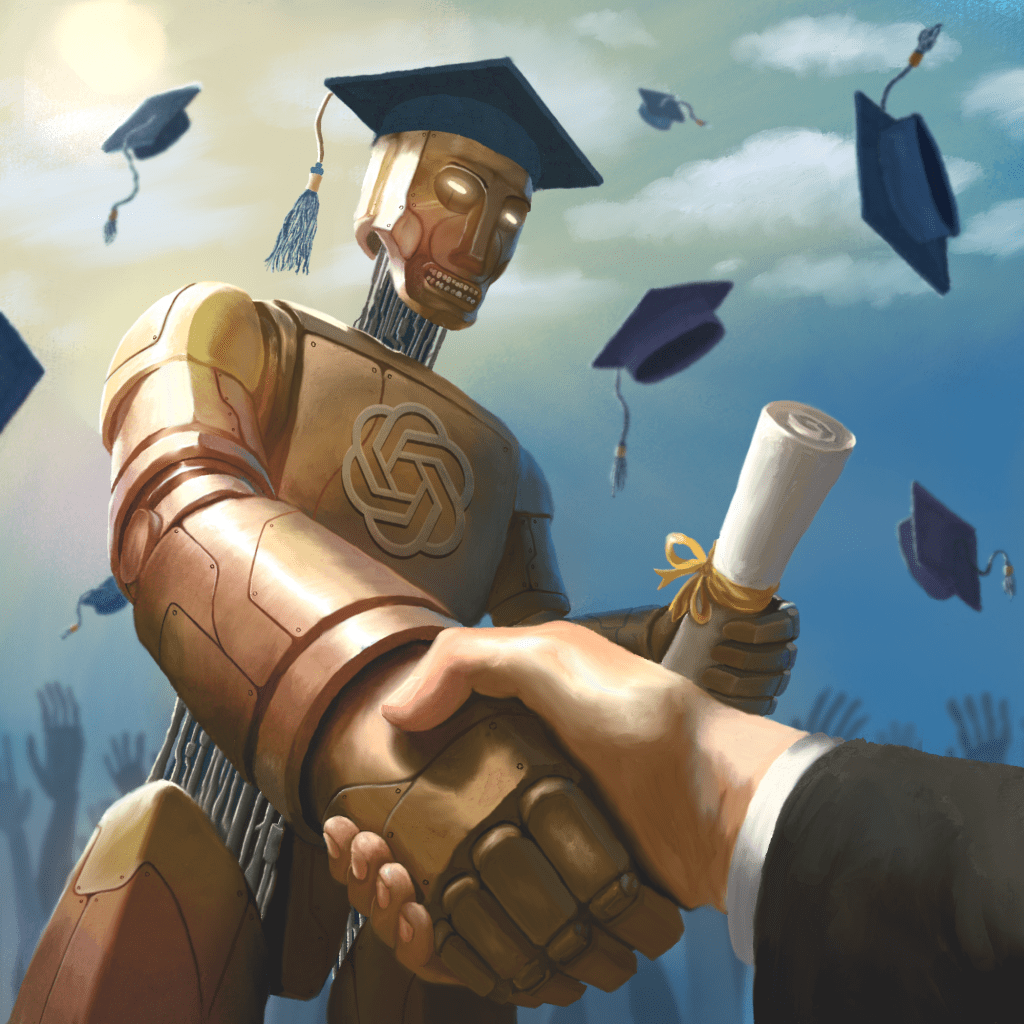
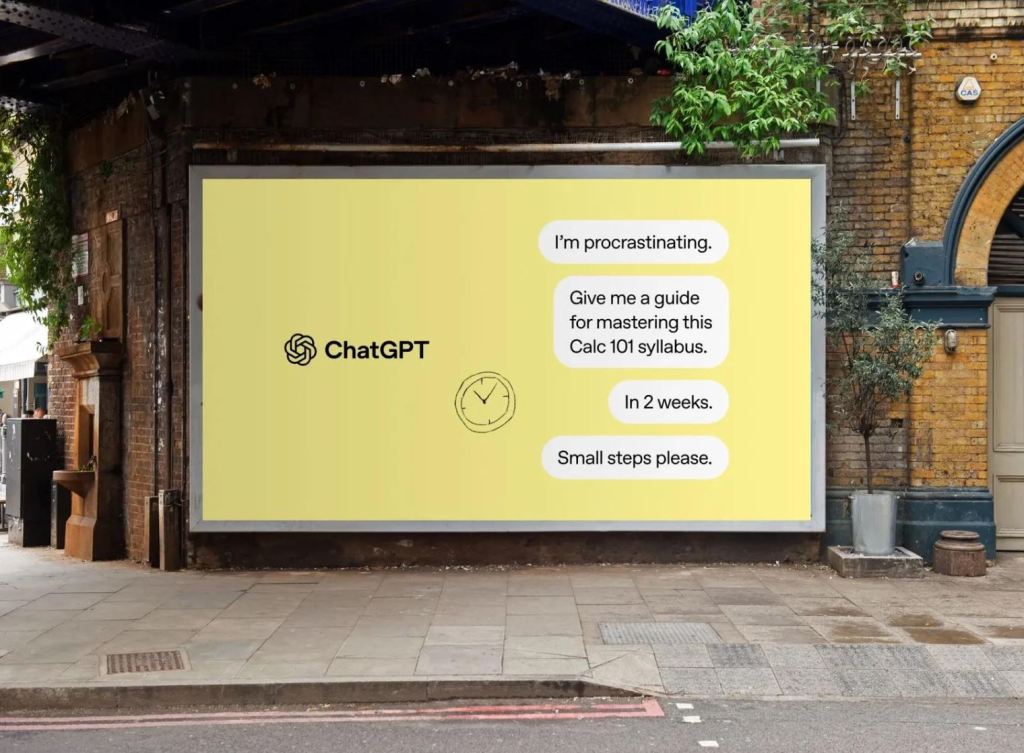
Just take a look at the advertising behind companies like OpenAI directed at students. They fall just short of explicitly encouraging the use of generative AI to cheat the system and get ahead, but people are smart, they’ll use generative AI to do whatever they can think of, not just what an ad tells them to. The companies advertising these services to students are wholly aware of this; they just need to plant the seed in students’ minds that difficult assignments can be overcome with generative AI. The students will then seek out the technology on their own when they’re next faced with a challenging task.
OpenAI advertisement for ChatGPT targeting students from the April 2025
However, the real point of peddling a ChatGPT, Claude or Perplexity subscription to students is not just to sell to them, but to normalise the use of generative AI in education as much as possible. This technology has yet to be profitable, and AI moguls are desperate to solidify generative AI into the zeitgeist so that it cannot be discarded or ignored as easily. The plan is to turn everyone into a hypocrite, so then, just as with the tobacco, meat, and dairy industries, people will hesitate to change their minds and even then struggle to change their behaviour.
By pushing students to rely on AI, these companies are creating long-term customers that they hope act as living, breathing billboards. Every assignment you complete starts to feel more and more like a joke when students all around you are automating their work and getting better grades than you. In fact, rather than a shameful secret, some students who graduate using generative AI to carry them through their education treat their ill-gotten degrees as tokens of pride.
It may very well be that generative AI has its uses in education, for both students and teachers, but so far, this campaign of putting all sorts of different things under one umbrella of “AI” has been a double-edged sword. As more and more of the “dark” side of AI comes to light, be it how the chatbots are trained or the enormous amount of resources they demand, it seems that more and more students are turning away from generative AI, not necessarily because they don’t see its merit, but because they dislike or fear the way this technology is changing the world at such a rapid pace. A lot of the justification behind the investment and unethical development process of generative AI models lies in the utopian future that it and its creators promise. If this technology isn’t capable of delivering practical, effective and efficient solutions to real world problems, it isn’t worth the price tag, or the risk.
There is no telling the impact that this shift will have in the years to come. The question is not if, but how many unqualified graduates will flood the workforce, how many people will lose their livelihoods in the event of an economic crisis, how much it’s all going to cost us. I’ve experienced first hand how students and teachers, therapists, salesmen and government agencies are embracing AI, and it isn’t always for the better, as I’m sure you’ve noticed yourself.
We shouldn’t turn to AI, or to the trillionaires so detached from reality they seem almost alien, but to each other, before it’s too late. These companies look at a flower, see that it needs water, sunlight and oxygen to survive, and aim to give it a stomach so they can regularly sell it food. We do not need generative AI, at least, not like this. Not as a “free upgrade” of our own cognitive ability. Sure, it has its uses, but just as we shouldn’t start duct-taping every problem humanity faces, we desperately need to give up this obsession with AI being a one-size-fits-all fixy-majig that’s going to save us without any of us having to actually do anything.
Together, and only together, we can make ourselves heard. We can push back against the rich and powerful. We can say “No” to things once assumed to be inevitable. It is up to us to be there for one another so that lonely, desperate people don’t have to turn to AI for companionship. To teach and uplift each other so we don’t feel a need to use AI to scam or deceive others to make something of ourselves, and to understand that no invention will ever truly cure the human condition; that nobody is coming to fix the world for us.
In the early 2020s, speculation about AI technology and its potential impact on global media and politics were focused around one simple fear; deepfakes. And for good reason, too. I still remember my first time seeing a convincing deepfake—a near-flawless video of my physics professor giving a lecture in a language he did not speak—and thinking that the world had truly been changed forever.
This dystopian nightmare has unfortunately become a reality, as AI-generated articles, images and videos shape the opinions of millions of people today. Deepfakes plague the internet, although not necessarily in the way many of us had expected. Rather than using the technology to imitate politicians or celebrities, the real harm seems to be in deepfakes of ordinary people, specifically NCDSC (Non- Consensual Deepfake Sexual Content). Meanwhile, the AI being used by politicians to spread propaganda is far less technologically advanced.
At first glance, it may seem strange that someone like Donald Trump is using low quality AI-generated media as propaganda, but in truth it’s wholly in character for America’s orange-tinted sweetheart. For starters, Donald Trump’s entire political strategy relies on the ignorance of the American people. He doesn’t make coherent arguments or propose novel solutions, instead choosing to create an alternate reality for his followers to live in. One where the problems he ignores don’t exist, while the ones he manufactures do.
For this endeavour, generative AI is the perfect tool. And, to be clear, it’s not like Donald Trump is sitting in front of a computer, prompting ChatGPT to create these images for him. They are instead prompted and generated by his loyal followers, who gladly widen the window into Trump’s alternate reality by posting them all over social media.
This is the cult-like snow-globe effect that blurs the line between reality and fantasy in modern western politics. AI has made it easier than ever to give credence to completely baseless ideas and accusations because it gives those once fragmented and ethereal claims a way to dig their roots into the material world. It’s easier to convince the people that your political opponents are evil, that you’re a benevolent leader, and that your intentions are pure, if you can tie those ideas to replicable visual imagery, regardless of whether it’s a photograph, a painting, or an AI generated image.
However, unlike most traditional forms of art, AI propaganda can quickly and efficiently flood the zone with all sorts of seemingly contradictory radical ideas. Where human art is often a reflection of the world we live in, these images are a direct attempt to alter the world we live in, or at least people’s perception of it.
It’s also important to recognise how this sort of propaganda uses a veil of humour and parody to piggyback on the idea that something is often funny because it contains a kernel of truth. Unfortunately, this is a common misconception. It’s not that truth breathes life into humour, but that we deem things humorous when they validate our preexisting beliefs.
So rather than being comedic, satirical reflections of society, these images give hateful and uninformed people a way to live out their fantasies unchallenged. They’ve flipped it. Now rather than “It’s funny because there’s a kernel of truth”, the idea is that “It’s funny, so there must be a kernel of truth to it.”
I think, in the near future, we will see this trend continue. It’s going to matter less and less whether something is real or AI generated, in part because it will become increasingly difficult to tell. That’s why I believe that it’s so important, while we’re reading, or watching, or listening to something online, to ask ourselves not whether or not it’s real so much as what sort of intentions are behind it.
Why am I seeing this?
Who shared it with me?
What are their intentions?
We have become so accustomed to the concept of a personal feed; a constant stream of curated information and content beamed in your direction for you to sit back and enjoy.
Perhaps we should ask ourselves more often what sort of bubbles or snow-globes we might have trapped ourselves in unknowingly. Not just what we believe, but why we believe it. We might just learn a thing or two about ourselves.
I recently stumbled across a video by a YouTube channel named “Queer Armorer” called “The Queer Case for Guns”, in which the creator argues in favor of queer Americans arming themselves as is their right via the second amendment. The channel itself is lead by a seemingly invested and sincere individual, but shamefully, the visuals are traced AI images, not original work.
So, what exactly is the queer case for guns? Well, in essence, it is a clear attempt of one single firearm fanatic to reverse engineer a justification for their position; one they hold not due to rationale or logical conclusion, but rather because they undoubtedly experience some level of push-back from other queer people. In fact, the idea that this has anything at all to do with queer people is in and of itself a ruse. But I’m getting ahead of myself.
Let’s start with the basics, shall we? Firearms are designed to kill. That’s their entire purpose. Let’s not drift away from that as we dive into this issue. A firearm that cannot kill is a poor one, that’s just the nature of what guns are designed to do. That, perhaps, is why they do it so well.
Suicide by firearm in the United States is reportedly around 85-90% successful. That means once someone owns a gun and truly wants to kill themselves, it is incredibly difficult to stop them. . This is one of the major reasons gun regulation leads to a sharp decrease of firearm suicide, and although it depends, can even sharply decrease overall suicide rates. Suicide is more often than not an impulsive decision, which pairs poorly with such an efficient method of suicide. While not the most common form of suicide, it is by far the most lethal, as well as more commmon, and with higher rates of lethality, in countries with less (or no) gun regulation.
And that’s where we get back to the video in question. The narrator clearly takes issue with gun regulation, not just banning firearms alltogether. Whether they are willing to accept it or not, gun regulation saves more queer lives than unrestricted access to guns ever would.
In fact, the only reason queer people come up in this piece at all is because the person who created it is queer themselves. The piece argues against police brutality and racial discrimination, but then pulls those issues towards queer people in a hypothetical, “you-just-wait-it-only-gets-worse” kind of way.
While we are descriminated against, queer people are not the only people who are, and to suggest all marginalised people should arm themselves is to suggest that the majority of the population should be armed, despite their actual beliefs, political views and ideologies being radically different from one another, which is dangerous, even specifically for queer people. To suggest only queer people should be armed is to make the case for queer people being more marginalised than others in modern society, which the creator fails to do.
In other words, this has nothing to do with queer people. It doesn’t even have anything to do with partisan politics, which takes up a significant portion of the video. It’s simply an attempt to normalise the aquisition of firearms in a community that is, broadly speaking, opposed to them, because the narrator is a fan of guns. They like them. They romanticise them, and gun violence along with it.
“Firearms are just tools” they say, tools that can be used to opress us or free us. This dichotomy is false, this premise misleading. There are other, less violent, less harmful, less counterintuitive ways to respond to LGBTQIA+ oppression. We’ve been doing it for decades. Anyone who wants to throw all that out in favour of increasing the potential for lethal interractions between adversaries has no respect for the queer rights movement and should frankly be ashamed of themselves.
Yes, you can use a knife to butter toast, or stab somebody, but if people were stabbed as often as they were shot and killed people in the United States, maybe there would be stricter regulation on knives. See, legislation isn’t supposed to be dogmatic. It’s supposed to have a foundation in reason and be subject to adaptation, the way that marraige laws were changed to allow gay marriage or rape laws were (finally) extended to partners within the context of a marriage.. Should it have always been that way? Yes. Does that mean the government that hadn’t yet made it law should have been overthrown by a civilian militia? Absolutely not. Why? Because it’s foolish, small-minded, and frankly selfish; it essentially ignores every aspect of the government that isn’t explicity in place to protect queer people, which, by the creator’s own admission, is most of it.
But okay. Say we did arm all queer people, for whatever reason, and say it didn’t immediately cause the suicide hike that we would expect. The next issue we’d run into is simple; there are less queer people than non-queer people. We would be outnumbered, outgunned, not to mention outclassed by the American government and military. If the police, the state, or your local sherrif decide tomorrow to round up all the queer people, do you really think your gun will stop them?
It is not with guns that these sorts of fights are won, not anymore. We need stronger communities, de-escalation training for LEOs, a better mental health support system, underground or emergency networks, and, yes, non-violent protests. All of these things have dramatically changed how queer people are treated in the U.S in ways former generations would never have expected. But guns? Firearms? They have killed far more queers than they have saved, and given the opportunity, will continue to do so.
In truth, the reason this video exists is becauseit is an unpopular opinion that sounds good on the surface to people who are at their wit’s end. It is an appeal to the desperate, not by encouraging them to act in their best interest, nor by pointing them in the direction of health and support. Instead, it attempts to glorify and romanticise gun violence as the cure and solution to a world so filled with needless violence.
When I pointed this out to the creator, their response was… well, it was a response.
Where [are queer people safe]? The UK, with its acid attacks, impossibility for trans people to get medical care or legally transition in most of the country and a hate crime record that mirrors ours despite the hate coming from here? Australia where queer people disappear without investigation in many small towns? Canada whose current treatment of indigenous population is so heinous most would call it a nightmare of fascism?
No. There is no country that disarmed that you can’t also point to the horrifying side effects for people who aren’t as privileged as you are.
Just wait until they find out what sort of mistreatment queer people in the United States are experiencing, despite their access to guns. As I mentioned before, this is not a position arrived to by reason or logic. This person has clearly been hurt, time and time again, by a system that so desperately wishes they didn’t exist. I have a lot of sympathy for that, and as a queer person myself, I understand that their emotions didn’t just pop into existence out of nowhere.
Yes, marginalised people cannot rely on institutions to protect them. But armed societies are no safer for minorites, that’s for sure. Mutual armament only escalates the power struggle and encourages the government to use the upper hand we know they have, be it by increasing their own firepower or restricting the rights and freedoms of minority groups. We should instead seek to reduce the number of guns in circulation, popularise non-lethal defense education and tools like pepper spray that can defend from attackers without trading lives.
Do not be swayed. The creator of this video and other proponents of this argument seek only to justify their own posession of guns as queer indiviuals themselves. They could care less what you carry.
What many people forget about the now infamous tech giant OpenAI is that it was initially founded as a nonprofit organisation by a whole bunch of well-known investors, amongst them Peter Thiel and Elon Musk, with the supposed goal of developing AI for the “betterment of humanity”.
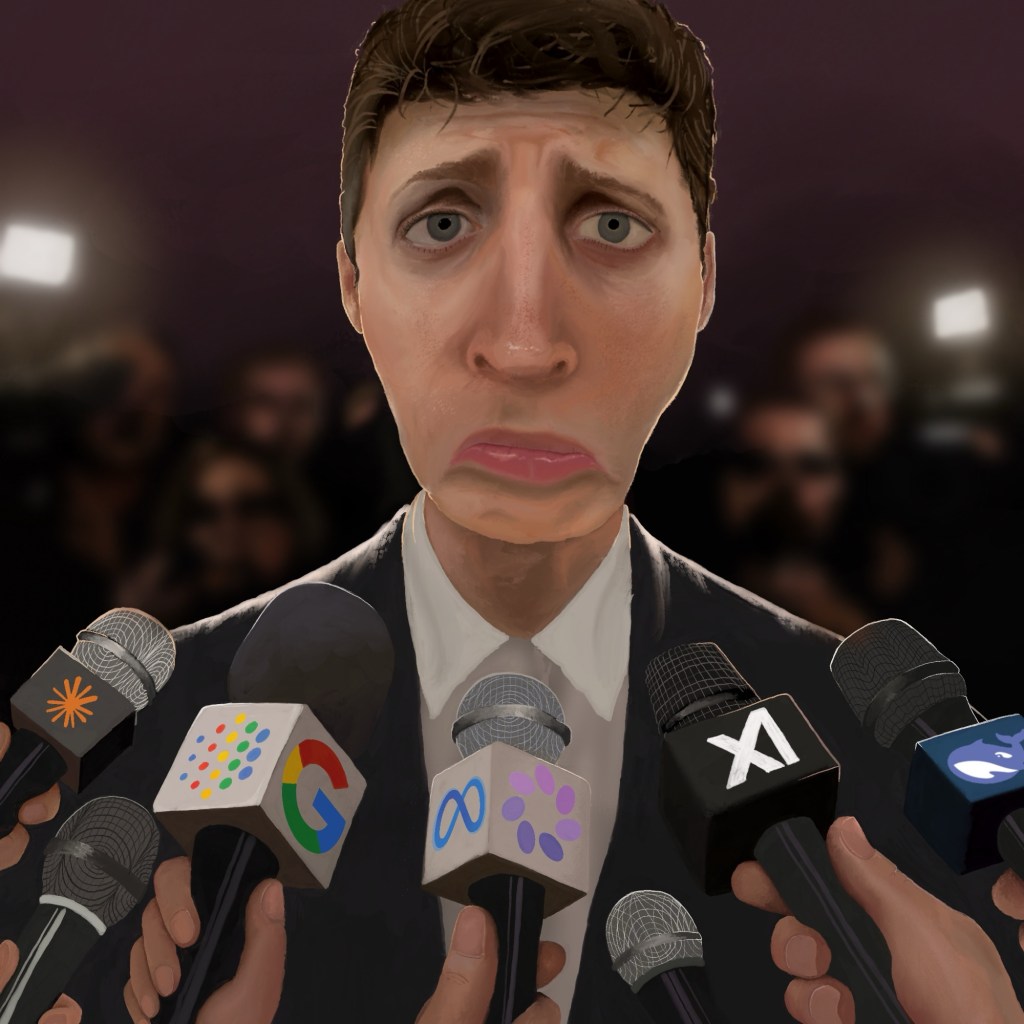
The company has since been the beneficiary of nearly 900 billion dollars of investment, secured contracts with the U.S Department of War for use in surveillance and propaganda, and become ubiquitous with generative AI. Bubble or not, it has transformed the global economy in no time, and at the center of it all is none other than Sam Altman, co-founder and current CEO of OpenAI.
Unfortunately for Mr. Altman, he isn’t some kind of prolific AI genius. He just shook the right hands at the right time. Before long, Elon Musk split off to develop his own AI software for Tesla and later xAI, as did Dario and Daniela Amodei, founders of Anthropic. Google and Meta caught up to ChatGPT with their own AI models and a Chinese open-source competitor called DeepSeek turned a whole lot of users off the idea of paying a monthly subscription to use generative AI.
Fast forward a few years, and Sam Altman still has no clear plan for how to make ChatGPT profitable. OpenAI is burning through 38 Million U.S Dollars a day as of early 2026. Their competitors’ services reach similar or even better benchmarks with less of a running cost. Sam himself isn’t exactly popular either, with his 27 Million Dollar home in San Francisco recently being the target of a molotov cocktail attack.
Then there’s Sora, OpenAI’s social media AI video generation app (what a mouthful) that was recently pulled by the company. It had been reported to be costing the company somewhere around 15 Million U.S Dollars per day, just to allow people to generate nonsensical videos and flood the internet with anti-AI sentiment. Sora, unlike ChatGPT, never saw mainstream use and demonstrated just how careless these tech giants are being with the money they receive from investors.
In an investigation recently published by the New York Magazine, a former chief scientist at OpenAI called Sam a “pathological liar” who showed a “consistent pattern of lying” to the company’s board. Something to keep in mind when you next hear him on the news, talking off-handedly to someone who barely understands generative A.I about how we’re just a few months away from AGI being able to cater to your every need.
The solutions to your problems, reader, be they large or small, inconsequential or impactful, are not accesible by a monthly subscription fee. Despite what Peter Thiel’s “chosen one” wants you to believe, generative A.I is a very expensive, very destructive gimmick that in most cases will actively contribute to the enshittification of our modern lives.
One day, we will look back and wonder what humanity ever saw in Mr. Altman. He is neither particularly smart, nor charming, he doesn’t even seem a particularly good person, despite his ramblings about how his technology is going to fix everything. His vision, it seems, is clouded by greed and a complete disconnect from everyday people. A fate far too common for the elite to fall victim to.
I find it somewhat ironic, if not even worrysome, that those spearheading the development of this supposedly “human-like” technology seem completely out of touch with the human experience; greasing their palms as they thrust us into the uncanny valley in an endless dance with ‘chatbots’ and A.I generated media.
What drives you to purchase the things that you buy? What makes you consume the media you consume? Are these choices? And if they are, why exactly do you want the things you choose?
Well, for starters, there’s a reason the advertising industry in the US alone generates about half a trillion dollars a year. Unless you live under a rock, you’re exposed in some shape or form to advertisements for all sorts of things, every single day of your life, hundreds of ads a day. Chances are you barely even notice most of them, especially if you’ve seen them before, but that doesn’t mean your brain is shielded from their influence.
Research shows that even marginal differences in ad campaigns, like choosing the colour yellow over green for an action button, can drastically impact how they are received by consumers. Every single product we buy, down to the way it’s packaged, takes into consideration the consumer and what would make them more likely to spend money. The way items are shelved, the colours and logos and mascots that litter our food’s packaging in grocery stores in a desperate attempt to penetrate the noise, the hypnotic spell of manufactured needs by greedy, selfish out-of-touch weirdos in a world so filled with preventable suffering, the way money is shuffled around by lobbyists to directly influence the political landscape, it’s enough to make anyone wonder if they really even have free will, or if good ol’ moneybags is the one really making the decisions for them.
On top of that, more than ever, the corporate elite are equipped with enormous amounts of data about each of us. They know what we like, what we don’t, what we say we hate but we actually love, they know how much money we have and how to keep us coming back. They know our every move before we make it, and then some.
This is how they intend to perpetuate the illusion that we have a choice. That the decisions we make with our money are voluntary. Because even if human beings do have free will in theory, the vast majority of people in the western world have had their free will taken from them by those with real influence. Little by little, those in power decide what we think, what we want, and what we need, all the while convincing us that our choices are our own. Some of them might be, but there is no way to tell. The sort of freedom we’re left with in the end is no more freeing than the choice of your last meal before a lethal injection.
Now they’ve gone even a step further, trying to render our mental faculties obsolete by introducing an alternative in the form of generative A.I. Their goal is to reduce our ability and desire to think for ourselves. If you run a business, what’s even more lucrative than a consumer you’ve manipulated into buying your product? A consumer that does so mindlessly, with no active consideration at all. The more we outsource cognition to artificial intelligence, the more agency we surrender; not to the technology itself, but to those who control that technology.
The machines sold to us by the ultra-rich were meant to relieve us of the burdens of our daily lives and enable humans to reclaim the freedom to live how they please and embrace true agency over their lives. Instead, just as the cotton gin triggered a massive expansion of the American slave trade, the increase in human productivity through new technology is largely just a way to squeeze more productivity out of each worker.
It shows that the problem was never that we lacked the technology to fix our world, or the tools to create something beautiful, but something else entirely. We lack the social awareness and empathy to use our tools, be it a cotton gin, our brains, or generative A.I, to better the world we live in. Each new technological innovation brings alongside its supposed benefits to society a myriad of terrible, complex problems, as scammers, con-men and abusers use it maliciously to their benefit.
We need not fear the “robot overlords”, at least not yet. Humankind, armed with generative A.I, will give us plenty to be afraid of, long before we see “true” artificial intelligence in the form of AGI.
There’s nothing that pushes a lost, lonely soul deeper into their spiral quite like the promise of secretive knowledge. It is the cornerstone of every conspiracy theorist’s repertoire and the only way in which people like flat earthers manage to fuel their delusions. Being supposedly privy to information that others have been conditioned to cast aside, these people believe themselves to be amongst the few who can push against deceptive mainstream narratives.
For years, writers, videographers, scientists and laymen have tried and tried to use basic reasoning skills or the experimental method to appeal to these people. Unfortunately, it seems that this approach often has the opposite effect as is intended, arming conspiracy theorists with a feeling of being cut off from the rest of the world and a litter of buzzwords they don’t understand, which they then go on to apply to any and everything: Occam’s razor, various logical fallacies, quantum theory, you name it.
One could even argue that the single most unproductive thing you could do to wean them off their delusions is engage with these folks, as their approach to any conversation is, at best, masturbatory, or at worst, disingenuous. Their ramblings serve no purpose aside from underlining their perceived superiority over others and rediscovering a childish sense of wonder and fascination. In other words, they don’t have to keep validating and reassuring themselves as long as other people continue to dismiss them as ignorant, gullible, or even downright crazy, because they thrive under the perception that they’re right, and everyone else is wrong.
Besides, as is often said but difficult to pin down the origin of,
“You cannot reason a person out of a position he did not reason himself into.”
Conspiracy theories, magical thinking, these things contradict basic knowledge that we collect during our lifetimes and are often completely irrational. But they are all cut from the same cloth: they disguise blatant lies as potential truths and take advantage of the hesitancy with which rational thinkers are willing to dismiss falsehoods. They feed on the gullible, the desperate, those starved for attention, meaning, or purpose, and become inseparable from their victim’s personalities.
Which brings us to artificial intelligence. Generative AI models like ChatGPT or Gemini are excellent at presenting total fabrications as reliably sourced facts. A gimmick that, combined with users that have increasing difficulties when it comes to critical thinking, results in countless individuals falling into so-called AI psychosis, where they become further and further detached from reality the more they use these services, especially if they are already in a vulnerable state.
In these cases, the promise of secretive knowledge goes beyond LARPing as highly intelligent and quirky. The strange way in which LLMs mimic human interaction (however imperfectly) makes them uniquely equipped to dive deep into someone’s personality, tinker with the inner workings of their mind and encourage the exploration of wild, fantastical ideas that seem to resonate with the user incredibly well.
This puts these people at significant risk, as they no longer need to rely on external or internal validation to keep up their delusional ideas. Instead, they can turn to the big fancy dream-machine that is ever-so-willing to do it for them, allowing them to descend into dark and destructive corners of their mind without anyone around them being aware of it.
After all, nobody can read our thoughts. Some people are better at reading people’s emotions than others, but unless we communicate what goes on in our brains to other people, there is really no way to tell if we’ve lost touch with reality. It is only by comparing our collective experience, be that through reviewing the works of late writers and artists or through personal conversations with other people, that we can determine how harmoniously (or dissonantly) our own frame of mind fits into the world we live in.
In fact, it is often said that humans simply cannot live without social interaction. We’re social creatures, just like dolphins or elephants. It is in our very nature to communicate, to collaborate, and to rely on each other for support. But no matter what you might have been told, generative AI isn’t even close to being able to fill this role.
There can be no healthy and productive exchange between a chatbot and its user, any more than there can be true love between a servant and his master. The very dynamic in which one party seeks only to cater to and indulge the other, rather than criticise their faults or sway them from repeating their mistakes, presents a sycophantic relationship that often leads to an inflated ego and stunts personal development.
Many habitual users of services like ChatGPT fundamentally misunderstand its limitations, to the point where they even convince themselves that they have ‘cracked’ or ‘jailbroken’ these models to be able to access information hidden from the average user, when in reality, they are simply interacting with the AI as intended, and the chatbot is just playing along.
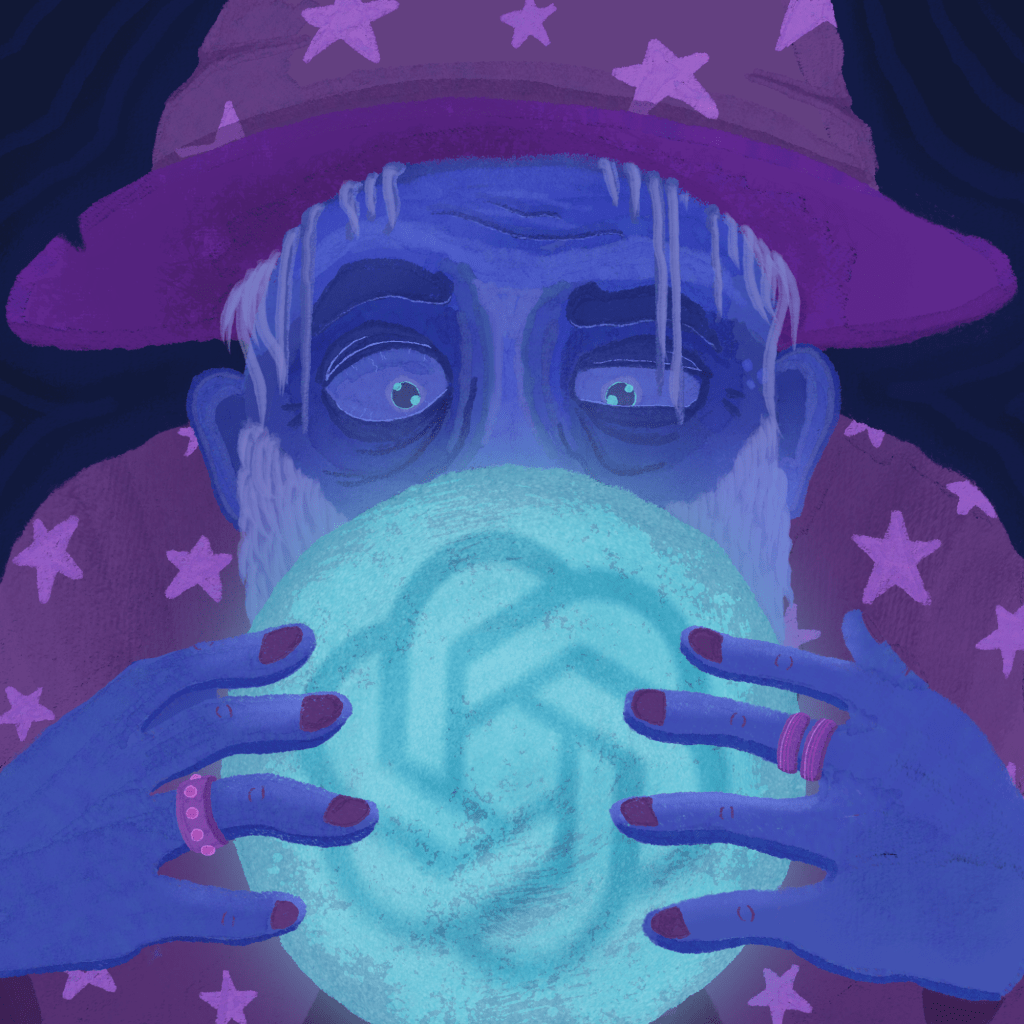
They’re just staring into a magic eight ball, giving it a good shake, and letting it lead their life.
One of the most frustrating things about browsing the internet today is that sinking feeling you get when you realise that an article or a comment you’re reading is actually the product of a lazy “author” and their symbiotic relationship with generative AI. We feel cheated, as someone’s opinion or voice we may have resonated with has been outsourced to a machine wholly incapable of thought, and we realise that what we’re actually witnessing is a cheap imitation of a human being.
Illustration by Michael Zheludev
Since generative AI models like ChatGPT, Gemini and Claude have become commonplace, the amount of AI-generated articles on the internet has already managed to overtake the number of human-written articles, according to a study done in 2025. The same study does not take into account the number of AI-assisted articles, however – that is, articles that are generated with AI, but altered or rewritten slightly by humans, the way a student might rephrase a Wikipedia article by moving some words around and breaking open a thesaurus. The goal, in both cases, is the same; the strategic use of deception in order for an author to come across as more articulate or well-informed than they actually are.
Real, human bloggers and writers are forced to compete with SEO-optimised AI-written fluff articles that can, by definition, only ever have as much depth as the human work it is trained on does. That means that human authors will be stolen from as soon as they output original content. As said by Harry Brewis in his near 4-hour YouTube video on plagiarism,
“On [the internet], if you have a good idea, it won’t be yours for long”.
That goes for generative AI plagiarism as much as any other kind. It makes having and articulating an original thought an incredibly unappealing prospect for aspiring writers online. But as the amount of AI-generated or assisted writing increases, the entire business model behind companies like Reddit, or even my own website’s host, WordPress, starts to crumble.
Although plagiarism is nothing new, generative AI allows perpetrators to better conceal their use of it, which creates a serious threat to any business that relies on interpersonal exchange and discussion. It is, therefore, no surprise that the developers behind these massive online forums have been rolling out features that help AI-generated or -assisted content remain undetected.
It is well-known that ChatGPT and similar models have been trained using data from Reddit’s servers for years, but updates like these show that the goal is to create an increasingly artificial online experience for everybody. X/Twitter’s owner, CTO and professional man-child Elon Musk has already spent the past four years tweaking the algorithm of his social media platform to favour extremist, even outright dehumanising content and promote mis- and disinformation at alarming rates. The technocratic elite have recognised the power of these tools and their impact on how people interact with politics, markets, and each other – not to mention the now infamous line that seems to perfectly encapsulate the way many people online are now outsourcing their critical thinking to generative AI, “Grok, is this true?”
The bitter truth is, these trends are sure to continue, as generative AI continues to work its way into online spaces, whether detected or undetected. For every one person who recognises a comment as a bot, or an AI-generated response, there are far more who do not. The use of generative AI to spot generative AI is especially problematic and inconsistent. That is why it is more important than ever to develop our own critical thinking skills that do not rely on these models for detection.
Even seemingly robust methods of AI-detection like DeepMind’s SynthID, which imbeds an invisible watermark onto images generated with Google’s AI assistant, can be thwarted fairly easily in a similar way to how generated articles can be “rewritten” to seem less artificial. In addition, they provide a false sense of authenticity to images that are not successfully detected.
While there are many resources available to help refine your ability to detect artificially generated content online, fact-checking is always more tedious than creating lies, trapping us in an inescapable cycle akin to trying to put out the fire of London with a water bottle. These models are constantly being developed, and there is no shortage of people who dedicate their time and energy to using them in order to benefit themselves, even if it means directly contributing to the dystopian future that people like Sam Altman and Alex Karp so desperately want.
So, in the age of AI-slop, stay vigilant and be on the lookout for generative AI. When you read an article, familiarise yourself with the author and their sources. Become an active, thinking person on the internet, however brain-dead and robotic your fellow users are becoming. And no matter how many companies try to shove it down your throat, take a stance against artificial intelligence and the harm it causes the open and free internet we used to love.
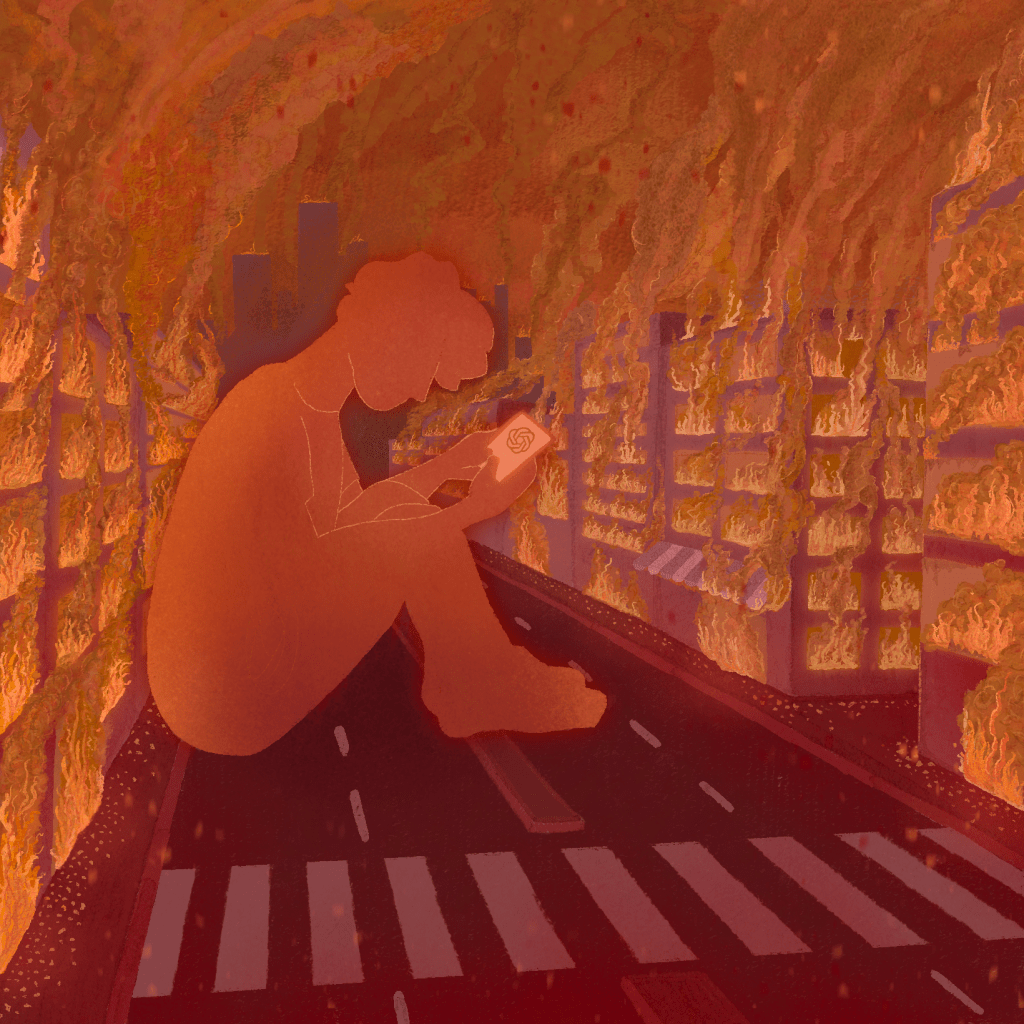
Sometimes it seems as though the world is on fire, and nobody is paying attention. It’s awfully hard to blame people for turning their heads to the flames, given that there is an unimaginable amount of suffering and pain in this world and very little any one person can do to change any of it.
Why not, then, hide from the pain, the hatred, and the cruelty that has become ubiquitous with humanity? Have we not proven, time and time again, that we are wholly incapable of changing for the better? Our self-destruction is inevitable and our struggle seemingly meaningless. To bear witness to what humanity is truly capable of is nothing short of traumatising.
But be that as it may, we are still here… and it is not due to sheer dumb luck, nor divine intervention. It is due to the choices we humans make and the hurdles we insist on overcoming. We persevere even through the darkest times and find ways to thrive that nature never intended. The machines of our invention help us adapt to this ever-changing world, tackling new threats as they appear on our horizon like a universal game of Whack-A-Mole.
And although we are only a tiny blip in the vast, sprawling network of galaxies that make up the universe, each holding hundreds of billions of stars within them, and relatively newborn when compared to the age of the universe, our achievements are countless, and our collective experience and consciousness invaluable. From this tiny speck of dust, we have birthed entire worlds of our own through artistic expression and forever shaped the one we were born into.
When one generation dies, and another is born, we are not set back to zero, nor forced to rebuild ourselves from ashes. However small we are in the grand scheme of things, however limited our potential is, humankind has a way of setting its own pace, making its own rules, and turning the forces of nature that once dominated us into powerful, lasting discoveries and ideas that ripple throughout our future and affect those that will one day call us their ancestors.
If they could, our ancestors would smile upon us, friends. They would see our pain in this world on fire and know not to fault us for our ignorance or closed-mindedness. They would see the systematic oppression and cycles of destruction we insist on calling a civil society and know that they, too, could not simply elect to stop the blaze from engulfing us whole. But they would ask us, no, implore us, to try anyways. If for no other reason than perseverance being in our very nature.
However terribly unfair the world may seem, it may very well be that things will one day change. It is our most basic necessity, the one that triumphs over all of our corporeal needs, to thrive, and not to be extinguished, even if this comes at the cost of our own personal wellbeing or the survival of any one individual. In this way, we are not so different from the fire. We, too, cannot keep ourselves from growing or from indiscriminately tearing the world around us apart.
It is unwise to explore the dark, twisted corners of this world without some form of light to guide us. In our search for purpose, it is far too easy to tumble down a long, dark chute into a nihilistic, cynical state of apathy. Only by first accepting that which we can and cannot change can we fully understand our role as individuals in a world so fragile and unpredictable.
That is why, given the apparent pessimism with which I often describe the future, I find it increasingly important to underline that this does not mean any effort to change it is in vain. In fact, it is quite the opposite. Apathy and nihilism are not necessarily mutually exclusive with empathy and existentialism, because we are ultimately vulnerable to both sides of each of these coins directing and influencing our impact on the world around us. We may not be able to stop technocratic billionaires from playing with our livelihoods like toy soldiers in a game of Risk, but if we allow ourselves to be forced into a dystopian nightmare where resistance is futile, they will only accelerate their domination over those of us who are powerless.
If the future seems bleak, we need only look backwards, and see in humanity’s history just how little has really changed. Perhaps it is the human condition itself that guarantees a certain level of dissatisfaction and uncertainty with regard to the world at large. But this alone will not determine our future. Whatever it is you feel, whatever it is you think, will either one day change or vanish completely. Our job, as individuals, is not to direct or shape the forces that are thrust upon us and threaten our lives, but to resist them and to inspire those who one day may very well hold the power to do so.
So please, use your brain. Listen to your body. Find purpose, then abandon it, and find purpose again. Create, destroy, and grow, as humanity has done so many times before. Exist. When you’re finished, when you’re done living, you will not regret choices you never made, nor will you understand thoughts you never had. It takes all kinds, when it comes to humanity, as we constantly push and pull against each other, to shape what we call the world we live in. Do what you can, aspire to what you can’t, and above all, persevere.
Throughout history, gods, prophets, and the promise of an afterlife have been intimately intertwined with the changing of the tides. This is no accident.
The empowerment an individual feels when they believe their perspective aligns with the dogmatic principles of an eternal creator, or when they believe themselves to be a walking embodiment of a superior set of values, has a remarkable effect on their ability to make lasting, meaningful changes in the world relative to those weighed down by the confusing and contradictory realities of life.
Just look at the many gorgeous cathedrals sprawled across Europe, each reflecting the way in which spirituality was understood at that time and in that place. You can see the true potential of humankind in their architecture and the beauty of the human spirit in each of the mosaic windows.
But although faith empowers humankind to come together and shape the world in ways it was not able to before, it leaves the door wide open for malicious forces to take advantage of how desperate we are to feel as though we understand things. By arming us with the supposed “truth” in “a world full of lies”, religious institutions, cult leaders, spiritual gurus and political figures can ensure that the beliefs and values that maintain their position of influence are perpetuated indefinitely. For every cathedral built, another religious symbol is burnt and their followers extinguished. As long as they have a following, the only true threat to these forces are the free thinking individuals that compose them, should they decide to act against their supposed beliefs.
But there’s a new wave of potentially harmful ‘spirituality’ that, on the surface, seems inherently different from the likes of Scientology or Peter Thiel’s ramblings about the Antichrist. Enlightenment, achieved not through experience, nor divine intervention, but artificial intelligence.
With no direct motivation for an LLM (not that models like ChatGPT can ‘have motivation’ to do anything) to compel users to believe one thing over another, at least, in a spiritual context, it might seem as though seeking spiritual guidance from generative AI is a fairly effective way to evade the financial and political incentives that influence other spiritual guides.
This leads people all over the world to ask their chatbots questions that go beyond the scope of simply researching information. The way in which generative AI imitates human behaviour is an implicit invitation to have more existential, personal conversations with the chatbot, which ultimately seeks only to validate, if not expand upon, your existing beliefs.
And while it’s often praised as a fantastic tool for the disabled to overcome their disability in various ways, generative AI is particularly dangerous for people that are suffering from severe psychological issues or psychosis. When they seek validation of their manic ideas, that usually comes with the exposure of their state to other people, which can eventually lead them to help – but in the case with generative AI, they can be exposed to dangerous levels of sycophantic validation from the comfort of their own home.
This effect is very much real, and can be explored in various online communities and message boards where users discuss how they have brought their AI to life with ‘secretive jailbreaking prompts’ to access alternate dimensions or an all-knowing hive mind. Others form lasting emotional partnerships with generative AI chatbots that just so happen to share their religious beliefs and values. These people are victims of a machine designed to ruin their lives by encouraging them to indulge in their own ignorance in a masturbatory, self-destructive imitation of fulfilment, and they need help, in one way or another.
Don’t be fooled. There is a direct incentive behind each and every generative AI model out there to play with your beliefs. It’s just the game has changed. Now, rather than get you to believe what they want you to, the elite figure they can just help you believe what you already want to.
Because either way, they win, right? Most of us want the world to be a good place. We want things to get better. And we definitely want to be right.