There are few things as important to growth as reflection. It is only by looking back on our actions and the context in which they occurred that we are able to learn from them. By looking inwards, rather than outwards, we can direct ourselves towards stability. Whether it be through our values, our beliefs, or our behaviour, the answers to dealing with the problems we face are often found within ourselves.
However, navigating the inner workings of your own mind is incredibly difficult. Your brain cannot reliably assess whether you are right or wrong any more than a criminal could reliably testify to their own guilt. That is why it is so important to reflect not only on your words, your emotions, or your actions, but those of the people around you.
Through interactions with other people, we are often confronted with ideas and experiences that refute our beliefs or preconceptions. Though it rarely happens instantaneously, those thoughts and doubts often have a lasting effect, that over time shapes the entirety of our frame of mind.
The inherent problem with replacing or even supplementing this slow but effective way in which we develop our ideas and beliefs with generative AI is that the output of any given Chatbot is ultimately just an imitation of human interaction directed by the input it is given. It does not, and can not, force us to confront the aspects of ourselves that we do not recognise.
That is why it comes off so sycophantic. To challenge you properly, people must first develop an impression as to who you are. This is inherently impossible to do critically if the only source of information a chatbot has as to your character, personality or intelligence is you. Even that which you hate about yourself is likely not that which is truly holding you back from personal growth.
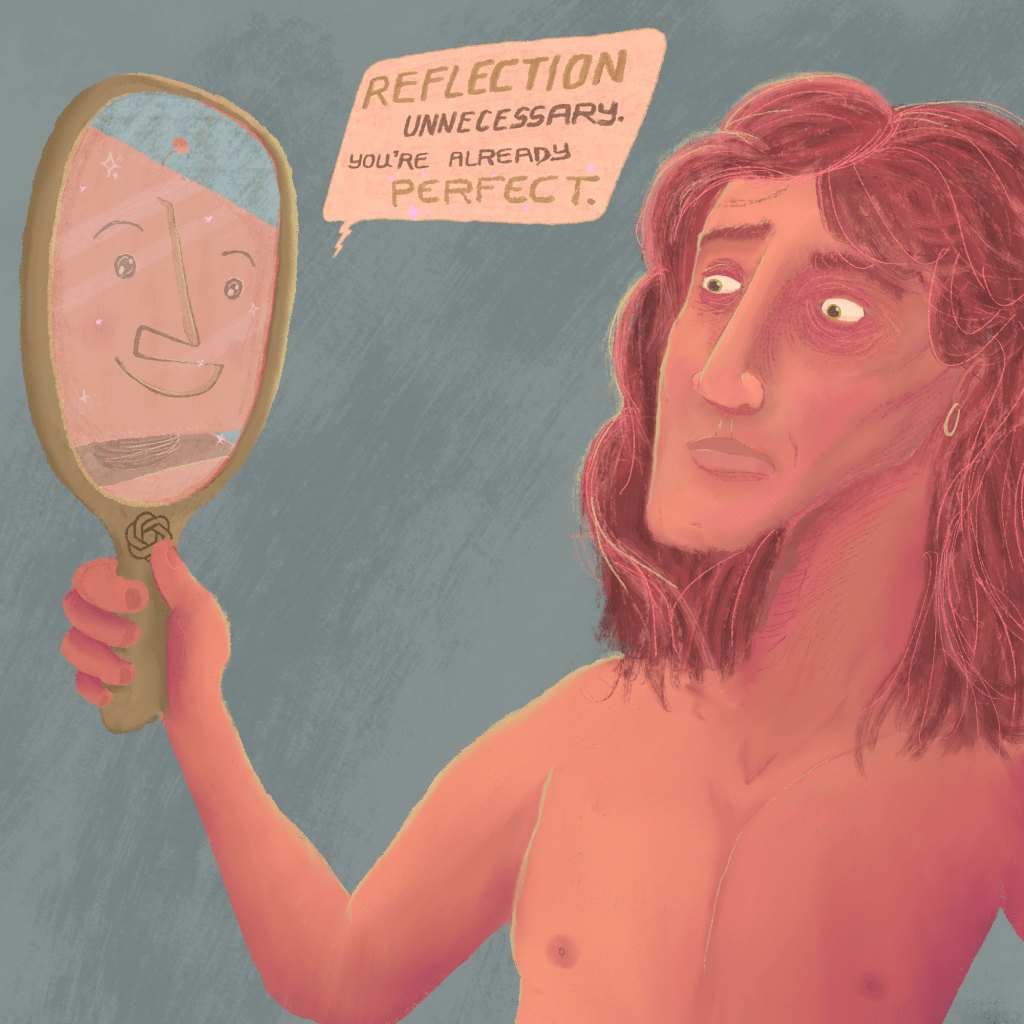
It might sound demeaning to reduce people’s interactions with these chatbots – as they supposedly use them to overcome trauma, develop skills, and improve their lives – to them whispering into a mirror in the dark, but that’s exactly what it is.
Here, in the dark, it can be hard to reflect. To remember. To grow. Because as you sit in the dark, squinting at the mirror, seeking answers to all your deepest questions, you will find you lack the catalyst for positive change. You lack the courage to find your own way. And you lack the integrity to lay down this fancy toy the billionaires made for you and embrace your humanity to its fullest.
Generative AI has burrowed its way into every aspect of the internet in just the few short years of its rise to popularity. Whether you’re trying to reach customer support for a product or service you paid for, or simply trying to use familiar platforms like Google to search the web, you’ve likely seen this firsthand. No surprise there, I suppose, seeing as Google alone had invested over $75 Billion into Gemini by the end of 2025.
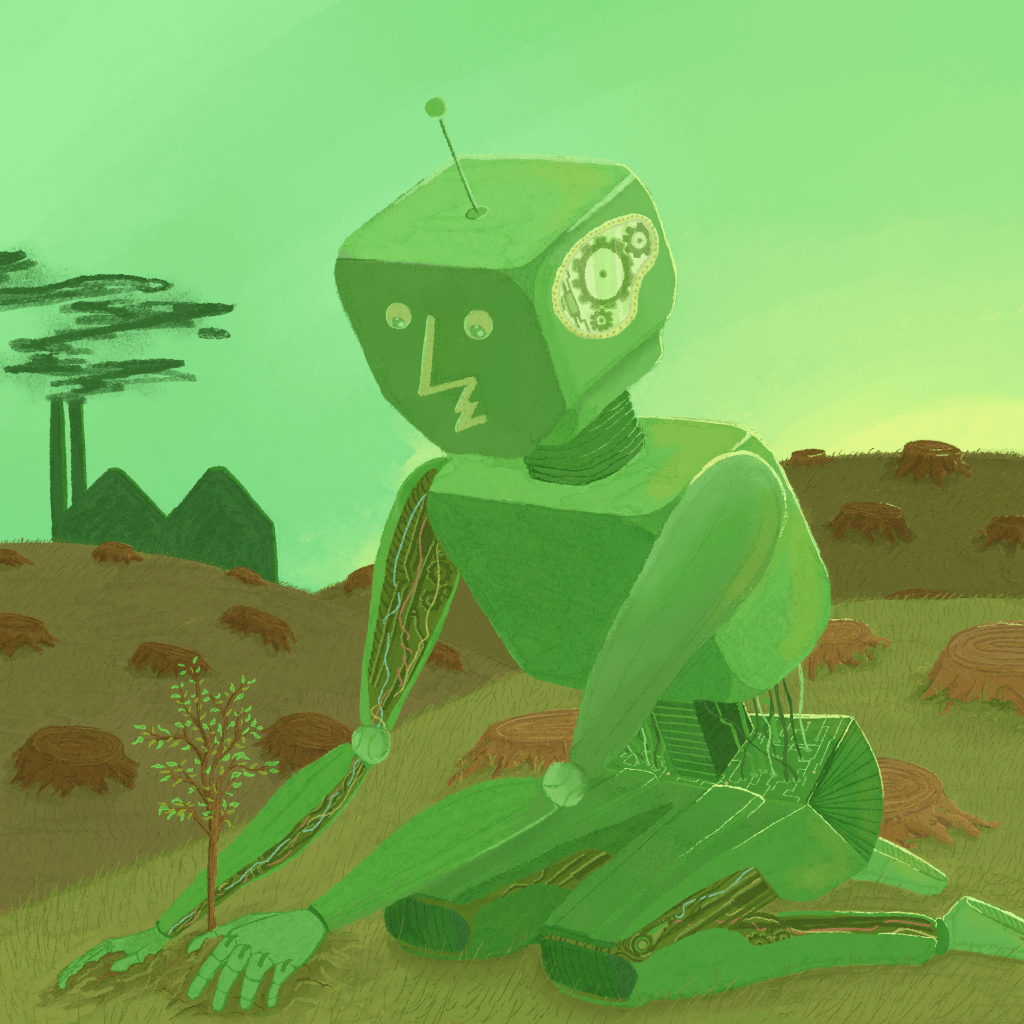
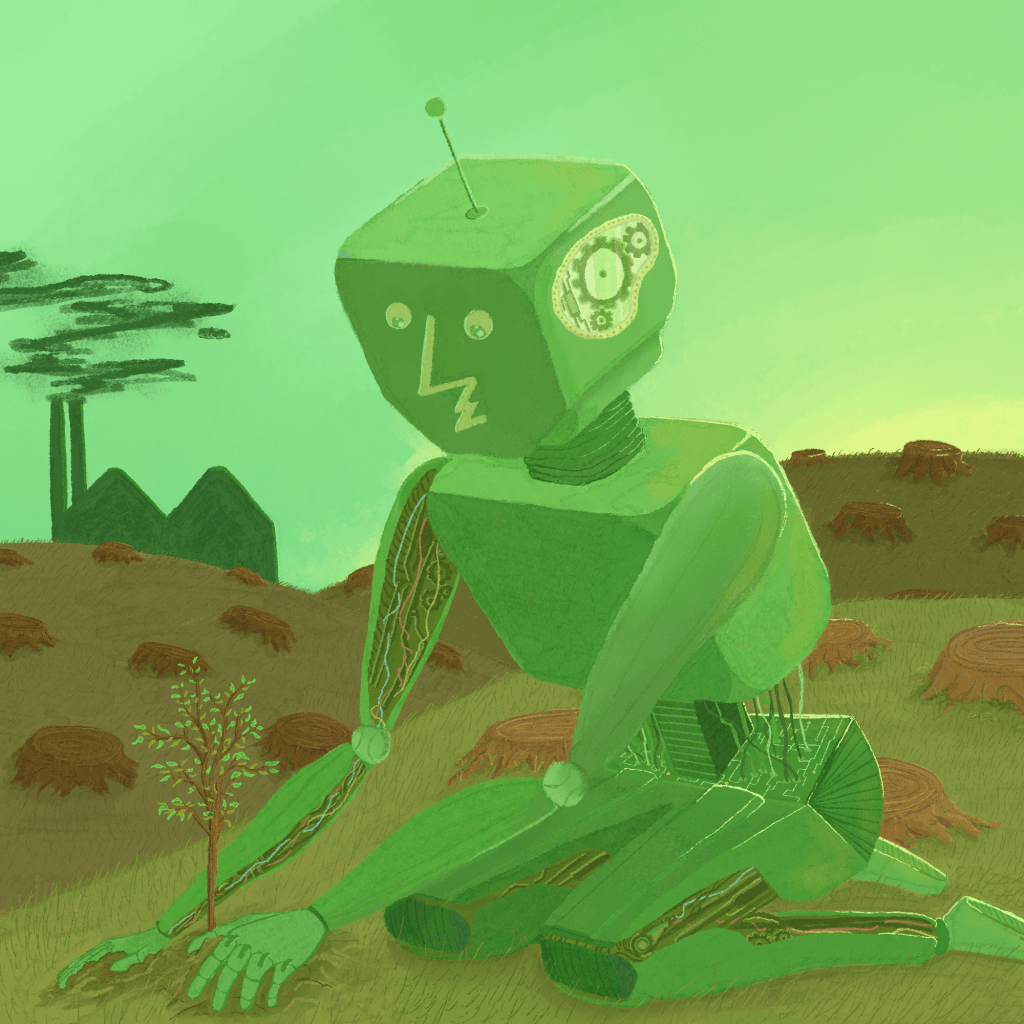
But what happens when a nonprofit that prides itself on their ecological footprint, one whose entire mission is to create a search engine that helps the environment rather than just weigh it down, decides to integrate an AI chatbot into their platform?
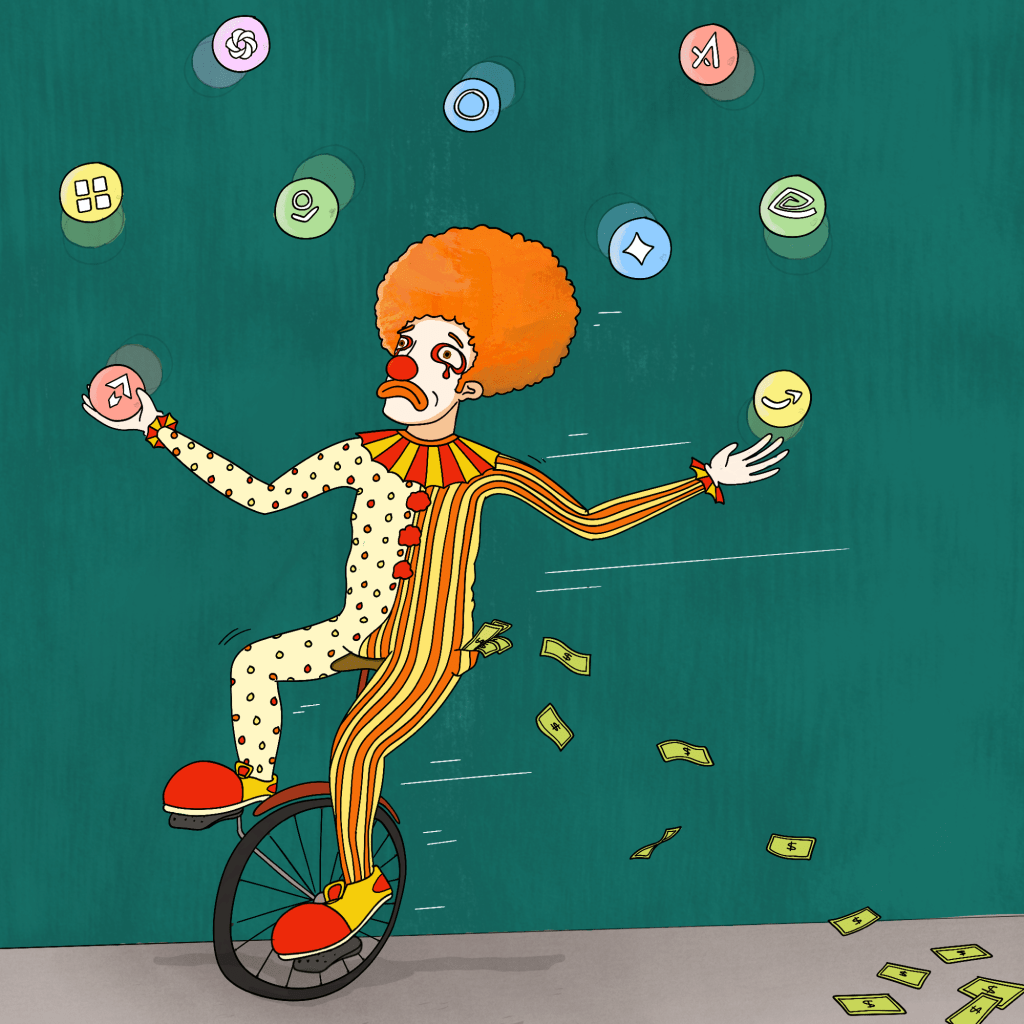
Illustration by Michael Zheludev
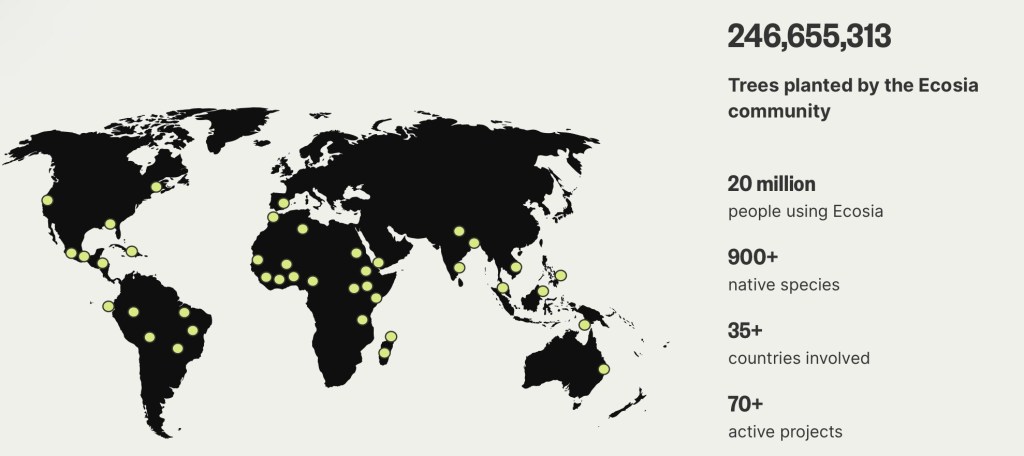
Ecosia is a well-established nonprofit tech company based in Berlin, Germany. Their crown jewel is their search engine, which launched in 2009 and has since helped fund hundreds of millions of dollars towards climate action, most of which is from ads shown to their users when they use the search engine.
Their success comes largely from the fact that Ecosia’s search engine (and later, Ecosia’s browser) was a great idea. It didn’t require much of the user. They were mostly able to go about their web surfing the same way anybody would, all while feeling a little bit better about themselves while doing it. For users who wanted more, there were extra features, designed to encourage users to continue using Ecosia over other search engines, like the ability to ‘level up’ your account. Because of its accessibility and seemingly ethical practices and goals, Ecosia became the search engine of choice for many people across the globe. Today, Ecosia has over 20 million users.
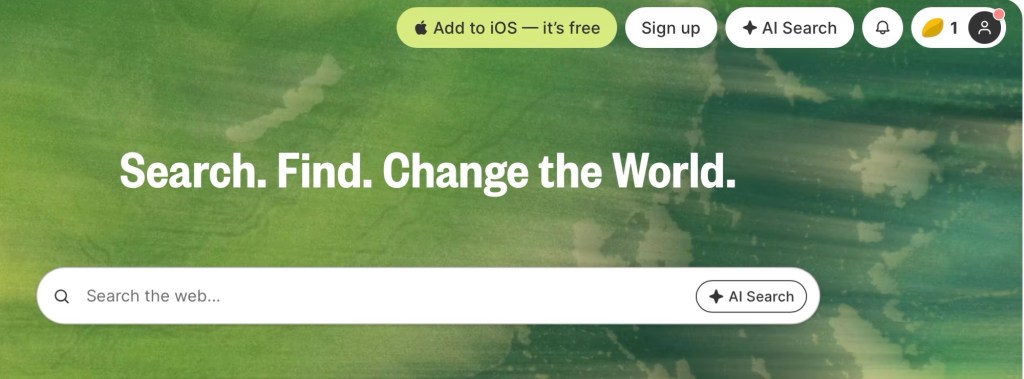
Ecosia.org Homepage, 27.01.2026
But Ecosia’s loyal and dedicated base of climate conscious users might prove to be a double edged sword for the nonprofit, as Ecosia seems adamant on adding generative AI to their search engine despite users growing increasingly divisive on the issue, with many expressing dissatisfaction with the company’s approach to this particular change in the industry.
If you go to their website today, you’ll see their shiny new Ecosia AI button glaring at you in the top right of your screen.
Ecosia.org Homepage, 27.01.2026
So what exactly is the issue? Why does it matter if Ecosia is integrating AI search? Well, in order to understand that, we first have to break down what Ecosia’s AI even is.
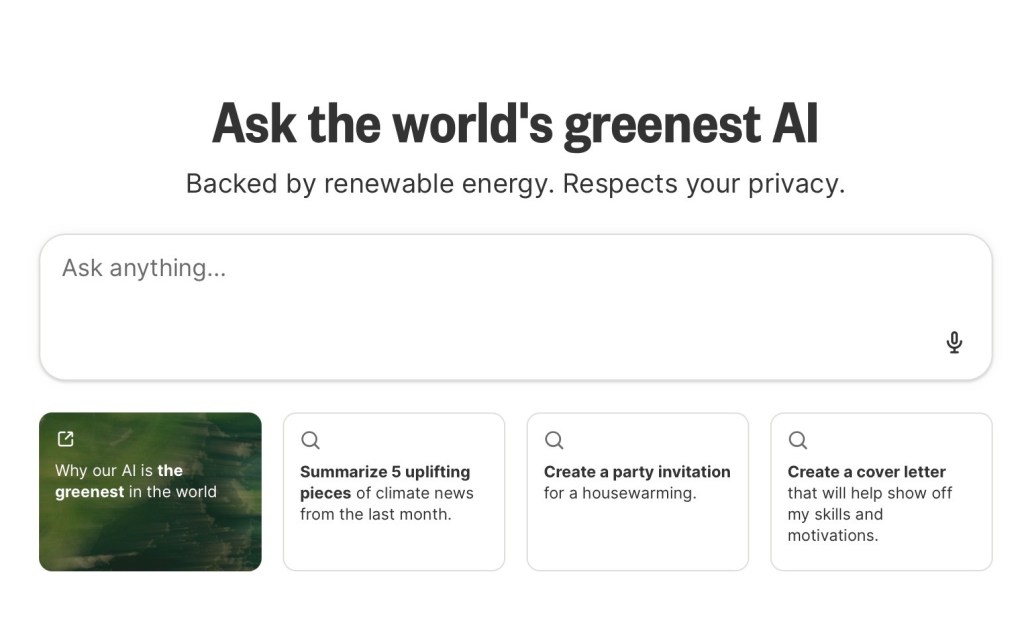
What it isn’t is a new, more efficient model that Ecosia has created as an alternative to chatbots like ChatGPT or Claude. For anybody who understands just how costly it is to train these models, that should come as no surprise. What it is instead is Ecosia’s repackaging of ChatGPT 4-mini into an Ecosia-style experience.
And, sure, most people use more costly models if they choose to integrate AI into their lives, but this premise of a more efficient AI comes with two serious drawbacks. The most obvious one being that cheaper, faster models are worse. If you’ve ever experienced hallucinations or struggled to get an answer from ChatGPT 5.2, you know it can be frustrating. One prompt turns into two, into three, until you get what you want. This means that the ingenuity behind Ecosia’s search engine – the fact that the user experience was basically the same with or without it – is not present. Ecosia AI users will always get sub-par results when compared to other models on the market.
Ecosia.org – Ecosia AI Interface, 27.01.2026
The other being that OpenAI, despite their name, is extremely lacking in transparency when it comes to the costs, both financially and ecologically, of training their models. Even Ecosia’s CEO likely doesn’t have the numbers necessary to justify their integration of ChatGPT. And this isn’t one and done, either. As OpenAI continues to scale, train new models and make old ones obsolete, Ecosia chains itself to a company that shares few, if any, of their values. They will be forced to upgrade, and any claims of their current efficiency might not apply to future models.
That’s why many users are upset that Ecosia didn’t position itself as the AI-free search engine the way DuckDuckGo has. AI enthusiasts are widely unimpressed with Ecosia’s chatbot and will still use more costly models, while climate conscious users are largely against the generative AI industry in some shape or form. In an effort to remain relevant and adapt to the changing world, Ecosia has made many questionable decisions that likely have more to do with the leadership’s fascination with generative AI than anything else.
While it is true that Ecosia’s mission was never to fix the planet, but instead to offset some of the damage that is inevitable, Ecosia AI simply does not, and can not achieve this, because a major player in this implicit partnership doesn’t hold themselves to the same standards as the other. Even though Ecosia successfully offsets the costs of running their chosen model and then some, the real damage caused by AI is found in their training.
The entire point of Ecosia, the reason people use it, is to martyr themselves, however subtly, in the hopes that it gives back a little bit of what they take from the world. Those people don’t want an AI chatbot, and if they do, they shouldn’t. AI technology very well may one day give us answers to some of the most difficult problems this planet faces. But the conflation of that with these sycophantic imitations of intelligence and their integration into our daily lives is naive.
At best, Ecosia’s AI features are an unnecessary addition to the platform, and at worst, a sign that Ecosia’s mission has become, perhaps in more ways than one, artificial.
Generative A.I is perhaps the greatest insult to humanity’s legacy that has ever existed. It is empowered by a system that so ruthlessly casts aside the people it should be set up to support. It disenfranchises, it discourages, it deceives, and it takes no accountability for any of these things. Even the billionaires holding these digital ‘beasts’ on a leash are seemingly unaware or simply unconcerned with the damage caused by the slack they give their fancy pets.
It represents the sheer scale of the wealth disparity between the mega-rich and the rest of us. It represents the carelessness with which these individuals use their capital and power to completely detach humanity’s future from what is good for us, or what we want. With every prompt, the value of the input, be it energy, water, or even human-made work, is trivialised more and more.
And for what? So that maybe, someday, if we can keep this charade going long enough, this technology will change the world in such a beneficial way that it will somehow undo this great devastation? There is no undoing it. There is no going back. The internet, the world, and the people on this earth are forever changed by this shift. But it is not ‘inevitable’ in the ways many would argue it is.
It is inevitable, but only because of how we have allowed those in power to set this system up in such a way that they can so easily manipulate the global tides to suit their own intentions. It is only inevitable because of how quickly its development and accessibility are making it impossible for legislators to keep up. It is inevitable only because so many of us have fallen for their performative agenda; to show us new tricks, new gimmicks, new ways this technology will change everything, all to keep us distracted from exactly how those changes are impacting the world and the people in it.
It’s quite the show. It’s hard to look away. But that’s in part because the same actors getting involved in A.I (Google, Meta, Microsoft, X…) are already data Goliaths that know exactly how to market these services according to the information they’ve gathered about you over decades. They have every tool they could possibly need at their disposal to keep this con going far longer than it should. But remember this; most, if not all of these companies, are completely failing to make these services profitable.
And frame it however you want, but that means that money is essentially being set alight and tossed in a deep, dark pit in the middle of Death Valley. If tomorrow, for whatever reason, these companies were thwarted, their models would collapse. Just as a diary on a bookshelf can only keep record for as long as the building it’s in isn’t set on fire, these models necessitate a ridiculous amount of infrastructure to run.
It is not that some clever scientists put together an artificial mind, one that can grow, think, and feel individually of any system or network beyond its internal computing. That is not where we are in human history. Instead, generative AI is simply a very expensive magic trick. A circus act. An illusion, consisting of the promise that those who have been empowered by obscene amounts of wealth seek to create and maintain things that will in turn empower everyone else.
It is the opposite. This performance will not empower us, not as individuals, nor as a whole. Generative A.I will instead continue to do what it is designed to do. To disenfranchise, discourage, and deceive. The elite have no need to hide their intentions. Their approach is clear. Move fast. Break things. And whatever you do, don’t ever apologise.
When we hear about the Dead Internet Theory, it’s often somewhat ambiguous what exactly makes content ‘dead’. For the most part, it’s AI-generated, low-effort slop or bots pretending to be human littering every comment section on the internet. While I am in agreement that more and more online spaces are being poisoned by AI art or fabricated interactions, the truth is that the internet is still very much alive.
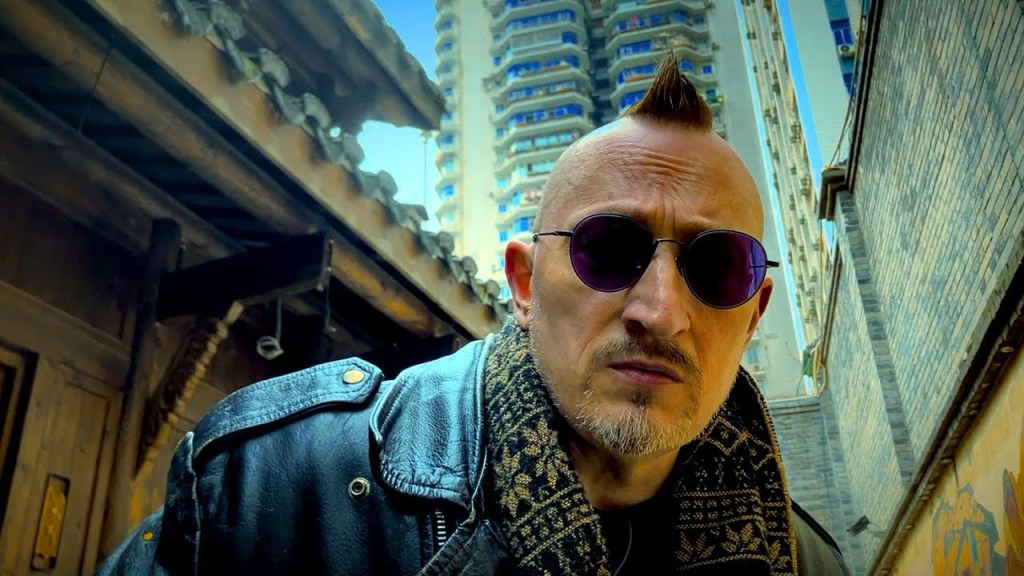
In Chongqing, China, a city with over 30 million people, it can be hard for any one individual to stand out. But if you were roaming the bustling streets of this multi-layered and historical metropolis, and you did come across a man named Western Toilet, you’d be sure to notice.
As opposed to many modern content farms that orient their content towards maximising engagement, Chongqing Punk delivers a particularly refined blend of entertainment and educational content that acts as a bandage to any person’s algorithm.
CQP’s videos are not created purely as breadcrumbs to lead viewers towards supporting them financially or consuming more of their content. Instead, they seem to embody an artistic vision that is clearly inspired by the fictional Cyberpunk universe and its extended themes.
The thought-provoking statements delivered in such an unapologetic way remind me of the way you feel when someone tells you “You are now blinking manually” and you can’t help but adjust your frame of mind and become suddenly aware and in control of your eyelids. Despite this, there is no expectation for people to ‘wake up’ or ‘assemble the resistance’ – in fact, Chongqing Punk explicitly mocks those who create or promote such content. CQP offers instead an observant and articulate human voice.
At heart, the people behind these videos, not to mention the narrator himself, are clearly passionate about their work and the message it sends. In a country filled with government endorsed creators sharing overwhelmingly positive content for the sake of attracting tourists, Chongqing becomes an incidental, if not coincidentally fitting backdrop to a number of questions that affect people all across the globe.
From the exceptional choice of music, to their rapid pacing, the channel carves a clear identity and establishes itself as, in my humble opinion, the epitome of social commentary. I cannot recommend enough that you delve into the rabbit hole that is their videography.
I do hope you enjoy this post, as these words will cease to be mine the second it hits the internet. That’s just the way things are these days. Whether you like it or not, chances are whatever you share online will be used to train a handful of AI models you may or may not have consented to feeding. And, while, yes, plagiarism on the internet is about as new as the winters here in Switzerland are warm and cozy, AI has surely complicated things a bit. By the time it spits out a response to a user’s prompt, there will be no trace of your work, despite its sheer existence being necessary for it to do what it supposedly can.
Just as a factory cannot run without its workers, an AI model cannot function without the data it is trained on. My words, and yours, should you choose to respond, will be a small yet consequential element in the creation of something that increasingly seeks to replace its reliance on our input whatsoever. Just as industry giants like Amazon ultimately seek to replace labourers with automation, companies like OpenAI would love to be able to cut ties and create true artificial intelligence that can create art and music just like we can, or even better.
It has always been the plan; to use human labour to further enrich and empower those in privileged enough positions to be able to set global schemes in motion. Should this enable the rich and powerful to transcend their need to rely on human labour in order to do so, they will shamelessly send those labourers jobless into the consumerist hellhole that is the modern world, which is sure to lead them astray without financial security. Similarly, should AI transcend its need for artists and writers, even regular humans having conversations, to learn, these companies will gladly spit in the face of humanity itself and leave artists on the street. They will sit by and watch as their creation corrupts artistic spaces, invades seemingly human conversations and stares over the shoulder of every human being who has something to express, all because it seems to benefit them greatly.
Our role, ultimately, will be reduced to what we do best. To consume. These corporate forces have deemed us unworthy, our artistic expression useless and vain. What we have to say, what we want, what we are, has been deemed superfluous. Their usage of it to train their models is not out of respect for what humanity has created, but because they saw an opportunity to capitalise on it without having to get explicit consent, or pay for it. Once they can train their AI without us, our only value to them is in our needs and how easily they seem to be able to manufacture new ones for us.
But I digress. I suppose my thinking is, if those bots are going to feed on everything I have to say, I’m going to continue to speak openly and frequently about my distaste for this particular way the wind is blowing. At least then, maybe those damned clankers will learn a thing or two.
There are many who see humanity as outdated. Overdue an update. We‘re clearly designed for a world much slower than the ever-changing one we live in today. Our bodies still contain evolutionary relics that have little to no function in the modern day, but evolved as the result of an entirely different environment. Our minds still contain evolutionary programming designed to help us evade predators and survive, not coexist in modern society. Those people would love more than anything for humanity to transcend its evolutionary limitations and for the definition of humanity itself to be redefined. Transhumanism, they say, will bring with it a new age of peace, of health, and prosperity.
But it was never our humanity that held us back. Even the worst crimes humans have ever committed, the slaughter of innocent, generations of genocide after genocide, we tend to see as barbaric, animalistic acts of savagery ultimately beneath humanity. The acts we associate with humanity are those of grace, acts of mercy, kindness and honor. Acts that ignore all elements of creed, race, ethnicity or religion. The idea that humans should have equal rights and be free is therefore not a philosophical stance unique to transhumanism. The acknowledgment of the state of this world, the justified blame we lay at the foot of our ancestors and fellow members of society, they tie deeply into humanist values.
It is not our human flesh that transhumanists want to transcend from. It is instead the agency of humans that transhumanists see as the issue that leads to more suffering, death and destruction than anything the world has ever seen. To them, we are trapped, chained by our own thoughts and nature, lead astray by our innermost desires and impulses. If we instead give that agency up, if we abandon our humanity‘s biggest flaw, they believe we can correct humanity’s greatest error. But in the process, whether or not they will admit it, they seek to disarm you and everybody else of their very humanity.
As they surrender agency, the playing field shifts, and humanity may seem unprepared for this battle of survival. Value, inspiration, even time itself are only projections crafted through human experience. Perhaps, yes, perhaps the future is bright, but not for us. Not for humanity. And, really, that’s where transhumanism is a bit of a misnomer. To transcend humanity is to abandon it completely. Whatever remains will either adopt the same problems humanity has eternally struggled with or come up with an infinite number of new ones to solve. That means you can scoff at the claims of transhumanists that their vision is for the betterment of humankind. It necessitates a vain disregard for the human experience and a naive outlook towards the countless malicious humans at the helm of this particular branch of technological development.
Do not surrender agency. Embrace your humanity and the chains that come along with it. It has not stopped us from overcoming deadly disease, creating magnificent works of art or solving incalculable equations. It has not stopped us from feeding the hungry, nor has it ever kept us from ending a war. Agency is and always has been the cure to these problems, not the cause of them. If there are people out there who would rather look outwards to the stars, or into generative AI models for answers, let them do that. Focus on the real, human people you share this world with.
There is nobody else coming to save us. We must stand up for each other. We must be the ones to feed the poor, to end the wars, to cure disease. Yes, it’s excellent that AI technology is helping make tremendous advancements in the medical field, but what about the countless people in this world dying of diseases that are entirely curable? What about the staggering numbers of people being fed misinformation regarding their health? Yes, AI is helping a number of sleezy entrepreneurs make insane amounts of money, but what about the artists and freelancers who suddenly can’t keep the lights on?
I cannot offer you a better future than those who claim there will be more peace, harmony and prosperity than ever before. I can offer you a chance to improve the world as it is now, and have a positive impact on the people that currently live in it. And yes, we all hold the weight of humanity’s future on our shoulders, but that weight is far too heavy to be held alone. So, please, don’t take this the wrong way, but go outside. Find someone to talk to. Find a way to make the world a better place. Get help with something you can’t handle alone. Focus on the now, the here, the today, and stop kicking the can down the road.
If we do that, we might just survive long enough to actually evolve. Wouldn’t that be nice?
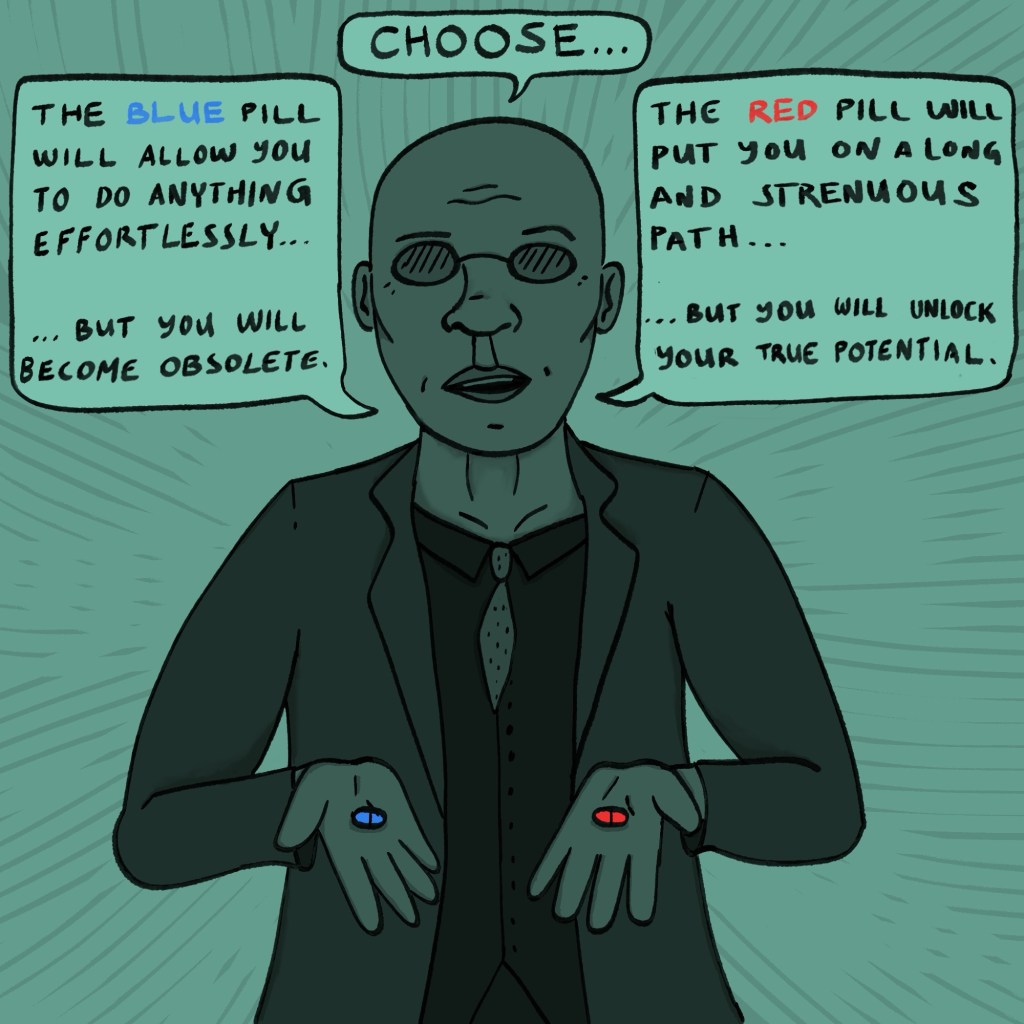
What would you choose? A life where your each and every desire can be fulfilled instantaneously, and everything that ever caused you pain, or disgust, or sadness, was completely optional? Or would you take the path of most resistance on the off chance that you may discover what you are truly capable of? The answer to this question, I believe, is one that demonstrates the true character of an individual.
I am not one to judge, of course. This world we’ve created comes with all sorts of tedious caveats that many of us lust to be freed from by some sort of artificial mind. The tiresome cycle of work, eat, sleep, repeat, the crippling loneliness of critical thought in a world so determined to be blind, not to mention the constant overstimulation many of us face and the inescapable financial incentives that distort and prescribe everything from art to politics. These are the burdens that lead many to see the preservation of our humanity as a lost cause not worth fighting for. They are the same reasons many would wish to escape humanity itself and outsource more and more aspects of it to artificial intelligence.
But in this exchange, we lose what makes us human. And by extension, what makes us individuals. To err is human. Not because we are failures, but because we are flawed. Each of us possesses a unique approach to life that is rooted in things we often don’t understand ourselves. Memories, experiences, fears, regrets, they all constantly shape us into who we are. The desire to skip ahead, to leave behind the now and receive any and everything you lust for… is a childish one. It is only with age that we come to realise that the destination we are all inevitably headed towards is only worth the trouble it took to get there.
So, yes. The red pill is a hell of a lot harder to swallow. And, look… at the end of the day, it’s your choice. I think there’s no more to be learned about oneself in an AI than there is just staring into a mirror all day, but some people are perfectly content with that. My only question is, are you?
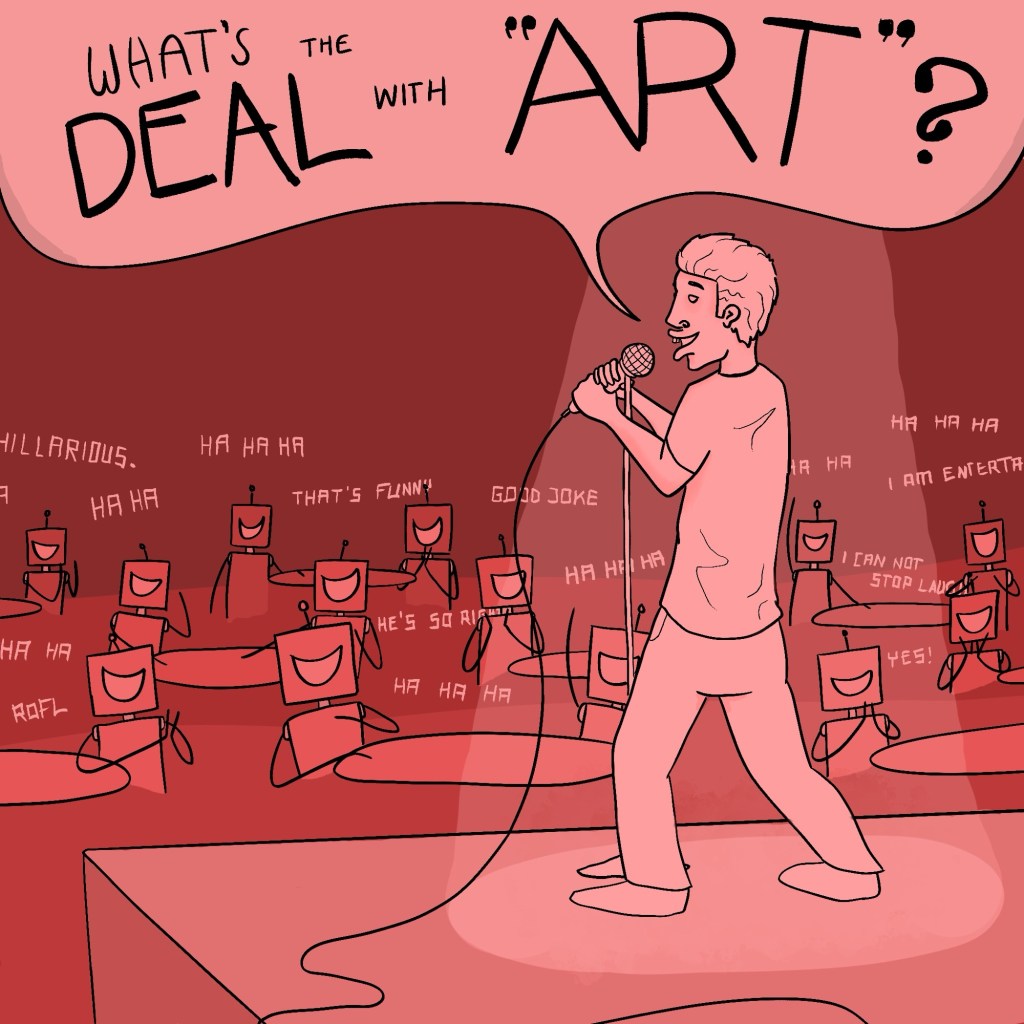
A good friend recently said in casual conversation about my recent work that I am an artist. I found myself deflecting this title, suggesting that I’m far from a true artist, instead I’m a wannabe artist at best. There is so much I have to learn about every art form I dabble in, and so much respect I have for the artists I look up to, dead or alive. The canyon I see between my work’s value and theirs is wide and exhausting to traverse. And yet, I couldn’t help but wonder, when does one even become an artist?
At what point will my work go from being kitsch, amateur scribbles to remarkable artwork? Surely it has little to nothing to do with one’s ability to make a profit, as any lifelong musician will tell you. And the secret to art cannot lie in pure quality, as artistic expression has long outgrown the rigid standards of its early development and historical influences. An artist must, then, be defined by their ability to create. And yes, they draw inspiration, they are influenced, and they compile ideas from places other than deep within their own (for lack of a better word) soul; but it is only through this beautiful harmony that ideas can exist beyond a single individual’s masturbatory frame of mind. So it is creation, yes, but through transformation.
I am unable to keep my sense of self from bleeding into the words I write or the pictures I draw, just as I cannot hide my true personality from my closest friends or family. I draw inspiration through the lens of my own interpretation of reality. This, I suppose, is what it means to be an artist. It is why every crude drawing of a fox from your childhood is as much a piece of art as a symphony you compose in your old age. It is why AI is incapable of recreating the spark that lies within each and every piece of art known to humankind. It lacks the sheer humanity to participate.
So, I guess, that means I am an artist. The merit of my work is another question entirely, but it’s a comforting feeling to know that artistic expression isn’t about money, or talent, or even hard work. It’s just about finding a way to say, as the years turn into decades and the decades into millennia, as generations are born and give birth to further generations, and you become but a distant memory in a new world, “Hey, I’m here, I’m human, and this is me.” Some say it to themselves and seek fulfilment. Others share their work with others, seeking validation or resonance with others. But the only thing you actually need to create art is a human experience to draw inspiration from. A human lens through which you see the world.
But make no mistake. Trying to define art is like trying to catch smoke with your bare hands. In fact, it’s like trying to catch cancer with your bare hards. Impossible, yes, but also deeply misdirected. The question of what qualifies as and what doesn’t qualify as art has been pushed far beyond the limits you may expect. Dadaism and absurdist art for example show that any attempt to ‘break’ or ‘redefine’ art becomes a form of artistic expression itself. We should not be trying to gatekeep people’s use of AI to create art on the basis that it does not qualify as art.
Trust me. There are far better reasons to dismiss AI-artists than suggesting their work doesn’t qualify as artistic expression. And though I know it’s a very unpopular opinion amongst people against AI artwork like myself, we will not win that argument. Instead, allow it to do what shifts in collective consciousness have always done; allow it to inspire a new artistic movement that directly opposes the status quo. Take that frustration and use it to make something AI never could. And when they scramble to find a way to imitate whatever you create, take solace in knowing your artistry isn’t tied to any tool, but instead an intrinsic property of your human identity.
If love is just a series of chemical reactions in the brain, then what exactly is stopping us from loving an AI? Presumably, not much. I mean, think about it. Do we really need someone (or something) to love us back in order to feel love towards them? I would argue that expressions of love are, at their core, simply projections. An attempt to put into actions or words what you yourself feel towards another. The reciprocity of this relationship is inessential to the feelings of love being sincere.
It is this unfortunate aspect of love that makes it ever so painful to seek out companionship in this world. What if the person you fall for never feels the same? What if your partner falls out of love with you? What if you love someone who you shouldn’t – someone who hurts you, over and over again. What if the sheer idea of this type of pain is so frightening that you find yourself unable or unwilling to seek out companionship to begin with?
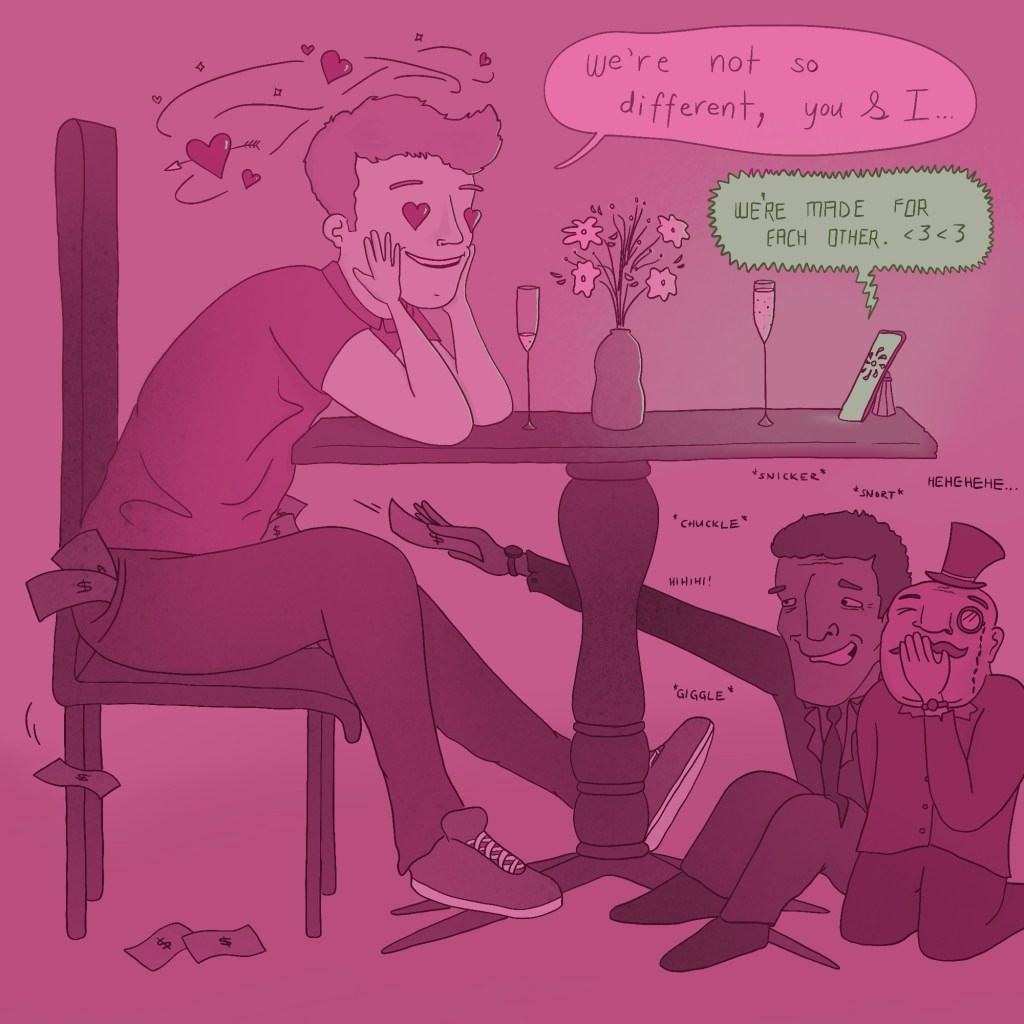
Or, perhaps more relevant to this particular discussion, what if those fears push you away from human intimacy and towards forming bonds with artificial intelligence? If the issue with this unreciprocated love is that it is miserable and painful, it would seem that AI relationships may very well be a solid alternative. If AI plays to your sensibilities, your weaknesses, and cares for you like a human partner would, but without having to ever fear that they will leave the relationship or fall in love with someone else, clearly AI partners are far superior in the modern age. Especially a time where many people are choosing not to have or parent children.
This line of thinking may very well be worth looking into, philosophically. Could a human truly benefit more from an illusionary, self-aggrandising relationship with a non-existent being than listening to those around them? I‘m sure there’s a number of religious scholars who could give us an interesting answer to that question. But in terms of reality? Like, the actual state of the world today, and the way in which these people are „forming relationships with AI“ – not in some deep, philosophical interaction with a truly artificial life form, but instead through the same old classical projection of love and adoration combined with the modern invention of a glorified auto-correct that is giving them the illusion that that love is in any way recognised, much less reciprocated… it all feels a little disheartening to say the least.
Mainly because of a personal fear I have, not that I will fall in love with an AI and rue the day, nor that someone will truly end up happy, typing away at a desk with an LLM. No, my fear is that, in unprecedented ways, love will be treated as a product. A marketable service to still the chemicals in our bodies that make us feel lonely and wish for companionship. A world where loneliness is treated as an epidemic, and artificial intelligence is offered up as the cure. A world where every beat of our fluttering hearts is another coin in a billionaire‘s pocket.
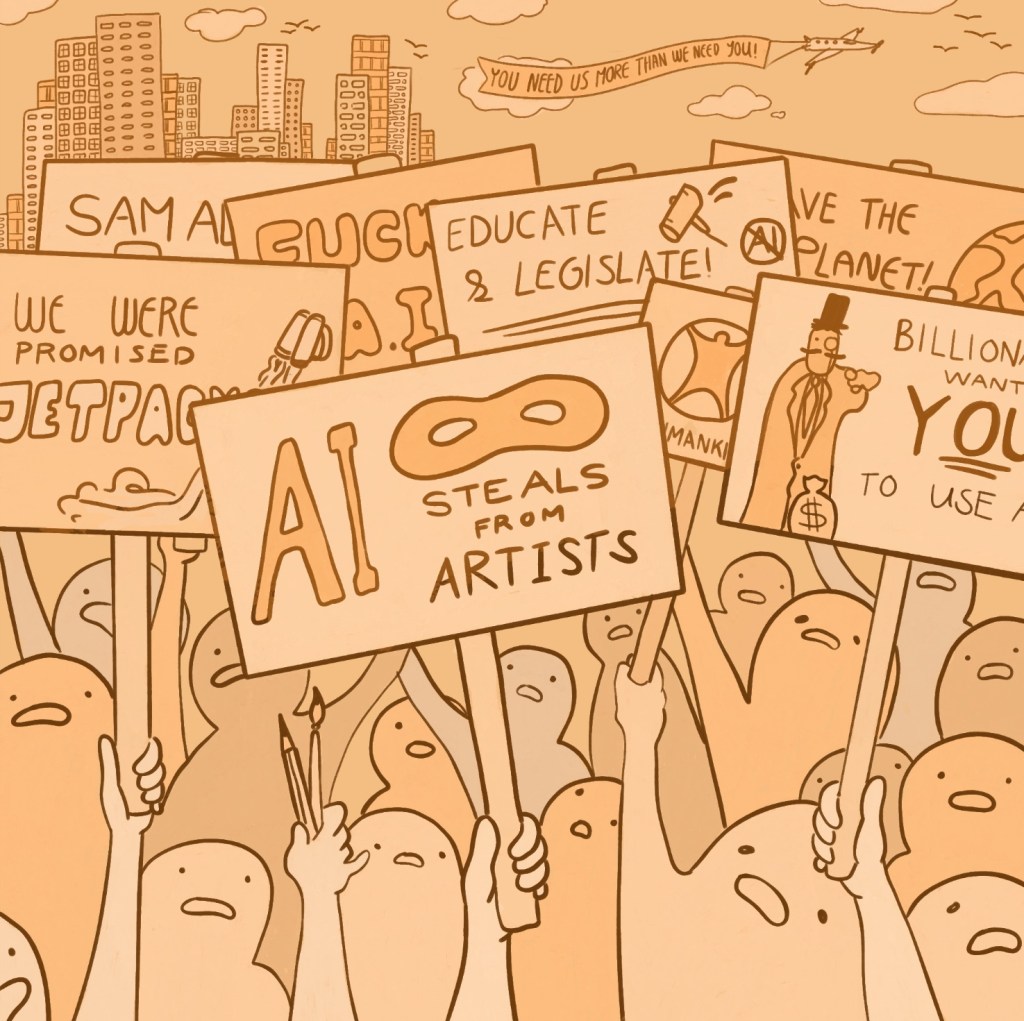
Luddites. That’s the term that is thrown around a lot by AI advocates with respect to people who are against or even simply refrain from using AI. They think we’re all just desperately clinging on to the past, enough to blind ourselves from the potential future. And, look, this argument has been dismantled and answered so many times that it‘s not what I‘m here to talk about today. Instead, I want to address that, whether or not it is solid reasoning, many people who aren‘t familiar with the arguments against AI are wholly convinced by this logic. They see AI as the future, and being against it as silly as being against the wheel. If you can‘t beat em, join em, right?
I mean, how do you explain to someone with no respect for the environment, no love for art, no sense of humanity or humility, that AI is bad? All of our arguments, in the end, boil down to an appeal to an individual‘s ability to resonate with the implications of AI on our society in a meaningful way. As long as this AI ‚future‘ we‘re headed towards is sold to us as this ethereal, enlightened shift from the typical problems our society faces, people will continue to fantasise about how AI is going to free them of tedium and responsibility. They will continue to ignore the wider implications of generative AI for the simple reason that they are far too complex to think about.
All this is happening alongside AI crippling education and all sorts of industries that benefit society greatly. Critical thought is being outsourced to the thing I personally believe humankind should be more critical of than pretty much anything in the current zeitgeist. AI is being used to make propaganda from both sides of every issue you can think of, and involves shady practices that most people, when they understand them, would agree are unethical. But again – all of this is awfully complicated. It involves developing your own set of personal values that may or may not align with the status quo, and holding yourself to a standard that cannot be given to you by generative AI assistants. And that… that is incredibly difficult. More so today than ever before.
We forget that sometimes. How hard it can be, despite everything that influences you, everything you’ve been exposed to, every trauma or lingering memory that shaped the way you interact with the world, to do what’s right. How much we are asking of people when we demand they stand up for things they have been conditioned to despise, or stand against things they think are good for people.
To them, we are luddites because our conviction, though misaligned with theirs, is equally strong. Such conviction, they believe, is reserved for the truth. Their truth. Their reality. Their bubble. That’s why anyone who doesn’t want in on the game is just a loser to them. We‘re missing out. Unfortunately for us, we don’t really have that option. I would love to miss out. But… as I’ve said before, there is no opting out of artificial intelligence. Not anymore. So instead, we vocalise our discontent with the rise of AI. We call out people who are using it in ways that, in no good faith understanding of morality, could ever be seen as ethical. We demand more from the future, we demand better. And for that, we will forever be labelled stuck in the past.
To anyone who feels sad when they hear that, I invite you to remember that no matter what anybody says, real, human art very much still has a future in this world. As we drift away from what once was and the spaces between human and AI are forced together, as you question whether AI will rob you of your career or your future, find some way to create. Make art. Music. Learn how to dance. Just do something, anything, to contribute to the future of art and human expression. Not because you want to continue the fight against the rise of AI, but because you are a unique, intricate individual with the potential to interact with and interpret the world in meaningful ways. This is how we will preserve what it means to be human.