
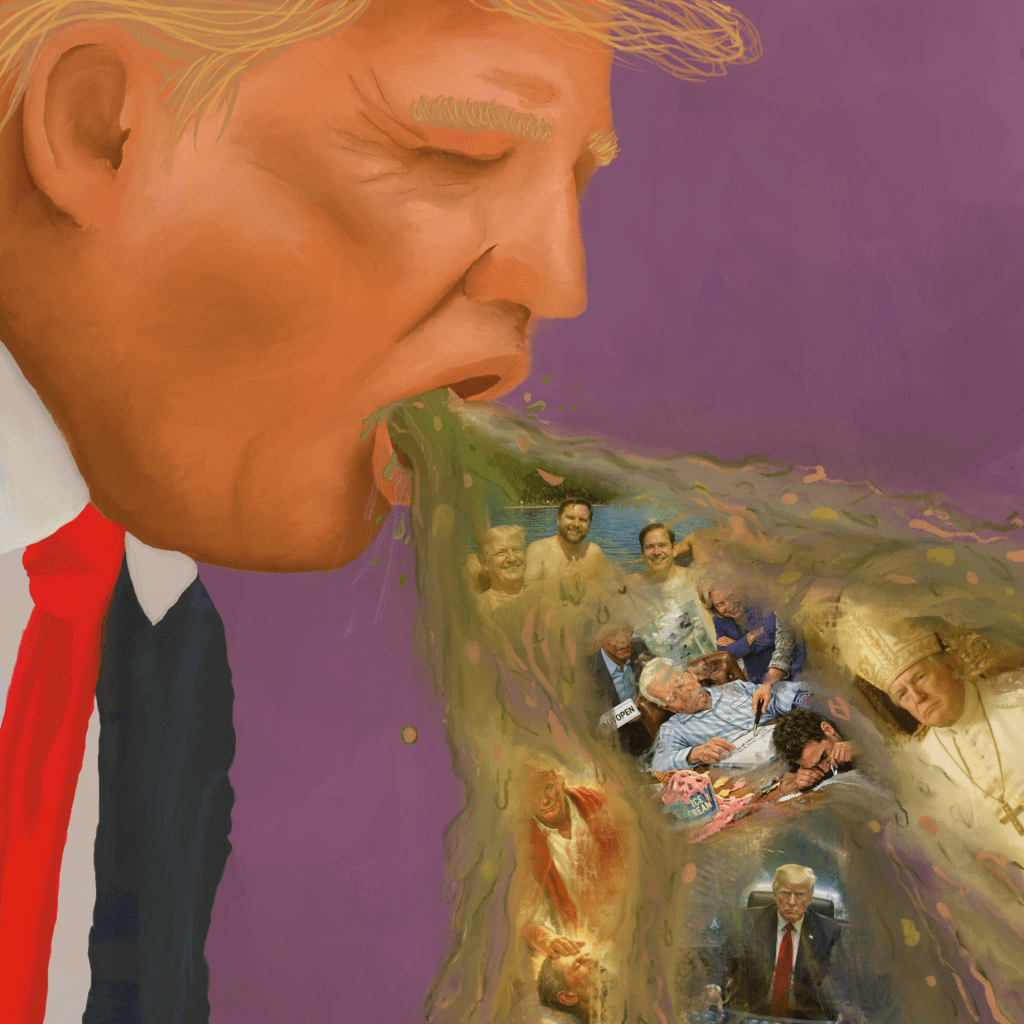
In the early 2020s, speculation about AI technology and its potential impact on global media and politics were focused around one simple fear; deepfakes. And for good reason, too. I still remember my first time seeing a convincing deepfake—a near-flawless video of my physics professor giving a lecture in a language he did not speak—and thinking that the world had truly been changed forever.
This dystopian nightmare has unfortunately become a reality, as AI-generated articles, images and videos shape the opinions of millions of people today. Deepfakes plague the internet, although not necessarily in the way many of us had expected. Rather than using the technology to imitate politicians or celebrities, the real harm seems to be in deepfakes of ordinary people, specifically NCDSC (Non- Consensual Deepfake Sexual Content). Meanwhile, the AI being used by politicians to spread propaganda is far less technologically advanced.
At first glance, it may seem strange that someone like Donald Trump is using low quality AI-generated media as propaganda, but in truth it’s wholly in character for America’s orange-tinted sweetheart. For starters, Donald Trump’s entire political strategy relies on the ignorance of the American people. He doesn’t make coherent arguments or propose novel solutions, instead choosing to create an alternate reality for his followers to live in. One where the problems he ignores don’t exist, while the ones he manufactures do.
For this endeavour, generative AI is the perfect tool. And, to be clear, it’s not like Donald Trump is sitting in front of a computer, prompting ChatGPT to create these images for him. They are instead prompted and generated by his loyal followers, who gladly widen the window into Trump’s alternate reality by posting them all over social media.
This is the cult-like snow-globe effect that blurs the line between reality and fantasy in modern western politics. AI has made it easier than ever to give credence to completely baseless ideas and accusations because it gives those once fragmented and ethereal claims a way to dig their roots into the material world. It’s easier to convince the people that your political opponents are evil, that you’re a benevolent leader, and that your intentions are pure, if you can tie those ideas to replicable visual imagery, regardless of whether it’s a photograph, a painting, or an AI generated image.
However, unlike most traditional forms of art, AI propaganda can quickly and efficiently flood the zone with all sorts of seemingly contradictory radical ideas. Where human art is often a reflection of the world we live in, these images are a direct attempt to alter the world we live in, or at least people’s perception of it.
It’s also important to recognise how this sort of propaganda uses a veil of humour and parody to piggyback on the idea that something is often funny because it contains a kernel of truth. Unfortunately, this is a common misconception. It’s not that truth breathes life into humour, but that we deem things humorous when they validate our preexisting beliefs.
So rather than being comedic, satirical reflections of society, these images give hateful and uninformed people a way to live out their fantasies unchallenged. They’ve flipped it. Now rather than “It’s funny because there’s a kernel of truth”, the idea is that “It’s funny, so there must be a kernel of truth to it.”
I think, in the near future, we will see this trend continue. It’s going to matter less and less whether something is real or AI generated, in part because it will become increasingly difficult to tell. That’s why I believe that it’s so important, while we’re reading, or watching, or listening to something online, to ask ourselves not whether or not it’s real so much as what sort of intentions are behind it.
Why am I seeing this?
Who shared it with me?
What are their intentions?
We have become so accustomed to the concept of a personal feed; a constant stream of curated information and content beamed in your direction for you to sit back and enjoy.
Perhaps we should ask ourselves more often what sort of bubbles or snow-globes we might have trapped ourselves in unknowingly. Not just what we believe, but why we believe it. We might just learn a thing or two about ourselves.


Leave a Reply